Posted by GC Support
on May 13, 2026

Table of Contents
Three or four months into a daily routine with a lithium orotate supplement, the same question tends to surface. Is taking this every day for a year, or five years, actually a smart move?
The word "lithium" sets off alarm bells for good reason. Most online searches pull up stories about prescription lithium used at much higher doses for bipolar disorder, and that history shapes the whole conversation. The supplement form sits in a separate category.
Weyland Brain Nutrition makes low-dose lithium orotate for people who read labels carefully and check the science before adding anything new. At the typical serving sizes used in dietary supplements, current research and clinical reports indicate a favorable safety profile for most adults, with a short list of exceptions worth noting.
Low-Dose Lithium, Designed for People Who Read the Label
Weyland's lithium orotate range starts at 2.5 mg and goes up to 20 mg, third-party tested and made in an FDA-registered, cGMP-compliant facility in the USA.
See the Full Range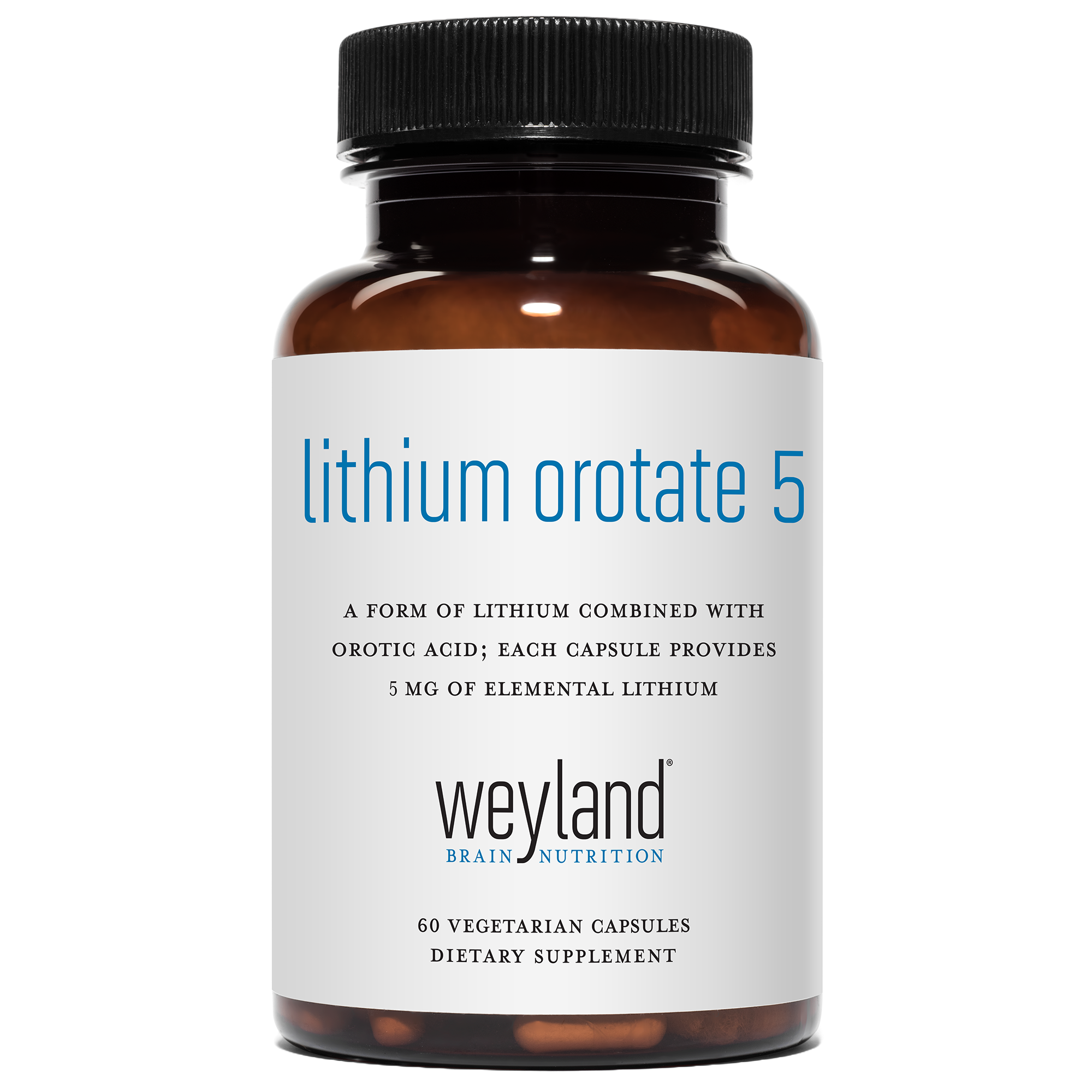
What Is a Lithium Orotate Supplement?
A lithium orotate supplement pairs the trace mineral lithium with orotic acid, a compound the body produces naturally during the synthesis of pyrimidines. Most labels list somewhere between 1,000 mcg and 20 mg of elemental lithium per serving, which is a tiny fraction of any prescription dose. Two distinctions matter before the safety question makes sense.
Low-Dose Form of Nutritional Lithium
The amount in a serving sits close to what people already get from food and drinking water. Daily intake from a typical diet ranges from 0.5 to 3 mg, depending on regional soil and the lithium content of local water supplies. A 5 mg low-dose lithium supplement adds a small, predictable amount on top of that background exposure.
Different from Prescription Lithium Carbonate
Prescription lithium carbonate is an FDA (Food and Drug Administration)-approved medication used in psychiatric care, mainly for bipolar disorder. Daily doses typically run from 600 to 1,800 mg. A lithium orotate supplement is a dietary supplement, not a medication, and the two are not interchangeable.

How Does It Compare to Prescription Lithium?
Putting the supplement next to its prescription cousin reframes the safety question in plain terms. The dose gap alone is over a hundredfold. Knowing where the supplement form sits next to prescription lithium helps frame the safety question honestly:
-
Daily dose: typically 5 mg to 20 mg of lithium orotate versus 600 mg to 1,800 mg of prescription lithium carbonate
-
Regulatory status: dietary supplement versus FDA-approved medication
-
Monitoring: no required blood tests at supplement levels versus ongoing lithium serum monitoring for the prescription form
-
Side effect profile: generally mild at low doses versus well-documented risks at therapeutic prescription doses
-
Intended use: nutritional support for mood balance, mental clarity, and brain health versus treatment of diagnosed conditions under medical supervision
What Does Research Say about Daily Use?
The research base on a daily lithium orotate supplement is smaller than what exists for prescription lithium, but it has grown over the past decade. Most of the older clinical literature examined the carbonate form at psychiatric-use doses. Newer work zooms in on the supplement range, which is closer to what shows up on store shelves and in everyday routines.
Limited Long-Term Human Trials
Long-term human trials on lithium orotate at supplement doses are still limited. Most published clinical work focuses on prescription lithium for bipolar disorder, where the dosing logic is entirely different. Population-level studies on lithium in drinking water, often described as epidemiological observation work, suggest that low-dose lithium supplementation may support mood balance and cognitive function in adults.
Toxicology Findings at Supplement Doses
A 2021 study by Murbach and colleagues evaluated lithium orotate in Wistar rats over 28 days and reported a favorable safety profile. The highest dose tested, 400 mg per kg of body weight per day, produced no observable adverse effects. Separate genotoxicity testing in mice also showed no harmful effects on DNA. The authors noted that the results align with decades of human consumption without a postmarket safety signal.
Common Reports from Daily Users
Survey data from people taking a low-dose lithium supplement points to a familiar pattern. A 2025 survey of 211 over-the-counter lithium users found cognition was the most commonly experienced improvement, followed closely by anxiety and mood. When asked to name the single greatest improvement, participants most often pointed to mood. Most reasons for daily use centered on gentle mood support, emotional balance, and mental clarity rather than treatment of any specific condition.
Find a Serving Size That Fits Your Routine
From a gentle 2.5 mg starting point to a 20 mg single-capsule serving, each Weyland lithium orotate option is built around researched daily ranges and tested for purity in every batch.
Compare the Options
Who Should Be Careful with Daily Use?
Not everyone should add a daily lithium supplement without a quick conversation first. A lithium orotate supplement is generally well-tolerated, but a few groups should speak with a qualified healthcare professional before starting daily use:
-
People already taking prescription lithium or other medications for mood
-
Anyone with kidney or thyroid conditions
-
Pregnant or breastfeeding individuals
-
Children and adolescents
-
Older adults on multiple prescriptions, since sensitivity tends to rise with age
-
Anyone combining several supplements that affect mood or neurotransmitters

How Can You Use It Safely Day-to-Day?
Safe daily use of a lithium orotate supplement rests on three habits that work together rather than in sequence. Sticking with researched serving sizes keeps the dose predictable, picking quality-tested products keeps the ingredients clean, and keeping a healthcare provider in the loop catches anything that might surface in a personal context. The three combined remove most of the minor risks associated with low-dose supplements and make the routine easier to track over the course of months.
Stick with Researched Serving Sizes
Most published guidance recommends a starting range of 2.5-5 mg of elemental lithium per day, with slow adjustments from there. Daily intake above 20 mg is not commonly recommended for nutritional use without clinical supervision. Tracking how things feel over weeks, not days, makes the decision clearer.
Pick Third-Party Tested Products
Quality matters as much as dose, since poorly made lithium products can contain heavy metals like lead or arsenic in trace amounts. Weyland Brain Nutrition manufactures lithium orotate in an FDA-registered, cGMP (current Good Manufacturing Practice)-compliant facility in the USA and third-party tests every batch for purity.
Loop in a Healthcare Provider
A short conversation with a healthcare provider helps tailor daily use to personal context. That matters most when other medications or chronic conditions are part of the picture, so a provider can flag potential interactions before noticeable effects appear.
You said: Role: You are an expert Technical SEO specialist and Web Developer.So, Is It Worth a Daily Habit?
For most adults, a daily low-dose lithium orotate supplement looks safe based on the current mix of toxicology data, clinical reports, and user surveys. The supplement form differs sharply from prescription lithium carbonate in dose, intent, and regulatory status. A few groups, including pregnant people, anyone with kidney or thyroid conditions, and people already on prescription mood medications, should check in with a clinician first.
Explore Weyland's lithium orotate range across 2.5 mg, 5 mg, 10 mg, 20 mg, and the 5 mg with magnesium and vitamin E formula, and pick the strength that fits your routine.
Ready to Start a Low-Dose Routine?
Pick the Weyland lithium orotate strength that fits your routine, whether that's a 5 mg daily capsule, the 5 mg formula with magnesium and vitamin E, or another option in the range.
Shop the Lithium Range
Frequently Asked Questions
Can you take lithium orotate every day?
Yes, research and clinical reports suggest that daily use of a low-dose lithium orotate supplement is generally well tolerated by most adults within the typical 2.5 mg to 20 mg elemental lithium range.
What are the long-term side effects of lithium orotate?
Long-term side effects at supplement doses appear uncommon and mild in current research, though more human data is still being gathered.
Do you need blood tests while taking lithium orotate?
Routine blood tests are not commonly required at supplement-level doses, though a healthcare provider may suggest them for people with kidney or thyroid concerns.
Can lithium orotate affect the kidneys or thyroid?
Clinical guidance suggests low-dose lithium orotate carries a much lower risk to kidney and thyroid function than prescription lithium, though people with existing conditions should still consult a healthcare provider before daily use.
What is the highest safe daily dose of lithium orotate?
Research and clinical guidance commonly cite 20 mg of elemental lithium per day as the upper end for nutritional use without medical supervision.
References
-
Murbach, T. S., Glávits, R., Endres, J. R., Hirka, G., Vértesi, A., Béres, E., & Szakonyiné, I. P. (2021). A toxicological evaluation of lithium orotate. Regulatory Toxicology and Pharmacology, 124, 104973. https://doi.org/10.1016/j.yrtph.2021.104973
-
Schrauzer, G. N. (2002). Lithium: Occurrence, dietary intakes, nutritional essentiality. Journal of the American College of Nutrition, 21(1), 14–21. https://doi.org/10.1080/07315724.2002.10719188
-
Strawbridge, R., Myrtle, S., Carmellini, P., Hampsey, E., Cousins, D. A., & Young, A. H. (2025). A survey exploring people’s experiences with lithium bought as a supplement: Une enquête sur l'expérience des personnes avec le lithium en supplément. The Canadian Journal of Psychiatry, 70(10), 782–795. https://doi.org/10.1177/07067437251328282
-
U.S. Food and Drug Administration. (2018). Lithium oral solution, lithium carbonate tablets, and lithium carbonate capsules: Highlights of prescribing information. https://www.accessdata.fda.gov/drugsatfda_docs/label/2018/017812s033,018421s032,018558s027lbl.pdf
Medical Disclaimer
The content on this page is for informational purposes only and is not intended as medical advice, diagnosis, or treatment. Always consult a qualified healthcare professional before making changes to your health regimen.
*These statements have not been evaluated by the Food and Drug Administration. Our products are not intended to diagnose, treat, cure, or prevent any disease.