Posted by GC Support
on May 20, 2026

Table of Contents
- 1. What Is a Lithium Supplement?
- 2. Why Are Researchers Studying Lithium and the Aging Brain?
- 3. What Mechanisms Are Proposed for Brain Support?
- 4. What Does Low-Dose Lithium Research Show So Far?
- 5. Who Tends to Look at a Lithium Supplement for Brain Aging Support?
- 6. How Can You Add a Lithium Supplement Sensibly?
- 7. Where Lithium Fits a Brain-Forward Routine
Lithium has been studied in psychiatry for more than seventy years, which makes it one of the longest-running stories in mental health research. Most of that history involves the prescription form at hundreds of milligrams a day. Over the past decade, the conversation has shifted. Researchers have started looking at what very small daily amounts may do for the aging brain, and that quieter question is where most of the lithium supplement benefits discussion now lives.
The catch is honest and worth saying up front. Most rigorous human trials still use prescription lithium at doses far above anything sold over the counter, which means the supplement-level research base is smaller and still developing. What follows is a plain-language walk-through of what the research suggests, what the proposed mechanisms look like, and how supplement-level lithium actually fits in. Weyland Brain Nutrition makes low-dose lithium supplements for readers who study the research before adding anything to a routine.
For Readers Who Track the Research, Not the Hype
Weyland's low-dose lithium range covers 1,000 mcg through 20 mg, third-party tested every batch, with clear labels that list elemental lithium per serving so the science can speak for itself.
See the Range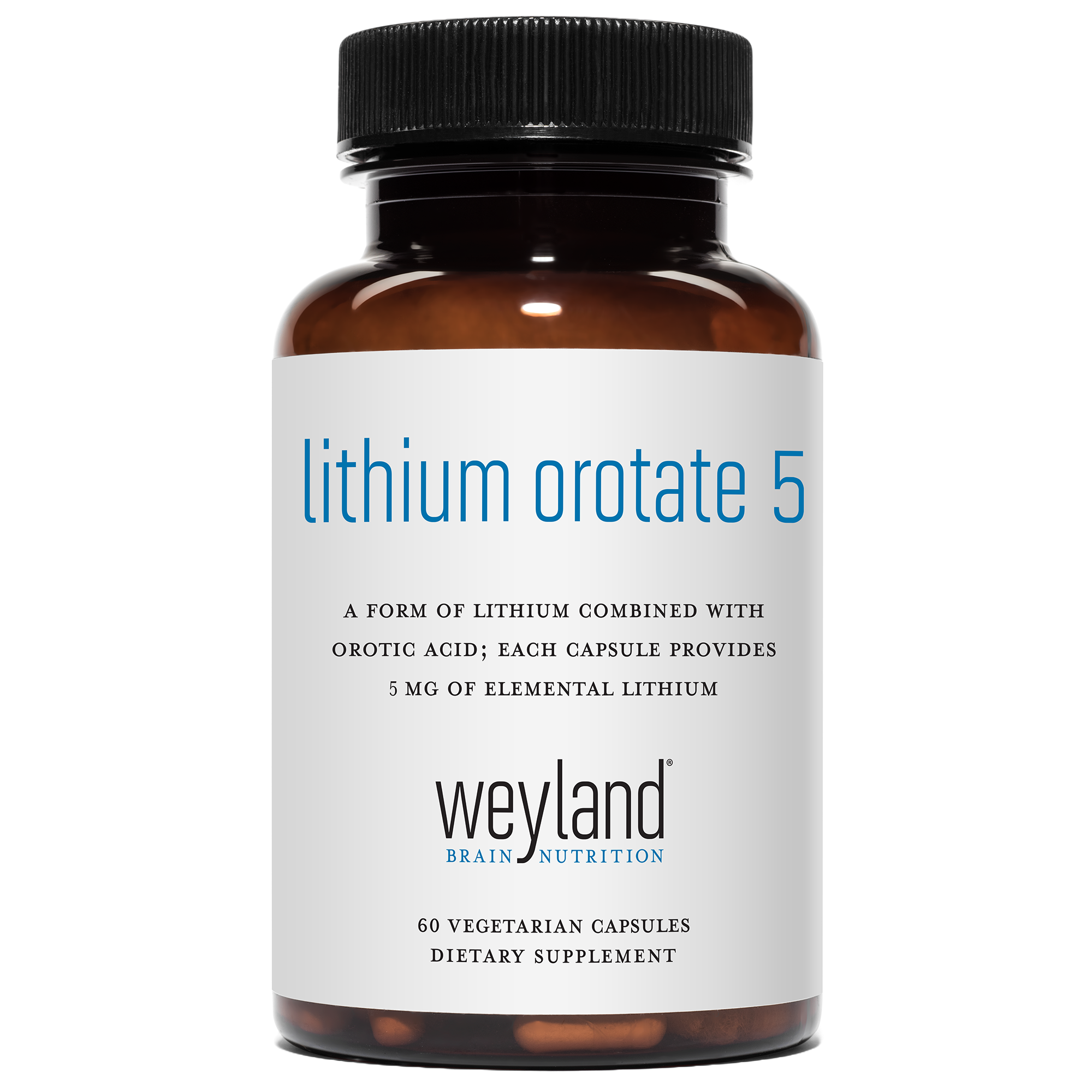
What Is a Lithium Supplement?
A lithium supplement is a low-dose nutritional product that delivers a naturally occurring trace mineral the body already gets in small amounts from food and drinking water. Most labels list servings between 1,000 mcg and 20 mg, well below any prescription dose.
Low-Dose Nutritional Form of a Trace Mineral
Lithium turns up naturally in groundwater, leafy greens, grains, walnuts, and a handful of other foods. Supplement forms, often lithium orotate paired with orotic acid or lithium citrate paired with citric acid, deliver trace amounts intended to fit into a daily routine rather than a clinical setting.
Different from Prescription Lithium Carbonate
Prescription lithium carbonate is an FDA (Food and Drug Administration)-approved medication used in psychiatric care, including bipolar disorder, at doses from 600 to 1,800 mg per day under medical supervision. A low-dose lithium supplement is a dietary product, not a substitute for any pharmaceutical lithium or psychiatric medication.

Why Are Researchers Studying Lithium and the Aging Brain?
Researchers have looked at lithium beyond psychiatric use because two different evidence streams kept pointing in the same direction. Population data and laboratory work both suggested effects on healthy brain function that did not have a clear explanation, and that combination is what turned the topic into a recognizable research category.
Population Studies on Lithium in Drinking Water
Population-level studies in several countries, including Japan and parts of the United States, have looked at links between lithium concentrations in drinking water and mental well-being. Researchers have explored connections to mood-related outcomes, though those findings describe whole-community patterns and do not translate directly to any one person's supplement decision.
Laboratory Findings on Brain Cell Pathways
Laboratory work has shown that lithium may influence several cellular pathways involved in healthy brain function. Early findings suggest the mineral interacts with enzymes and proteins tied to how brain cells signal, grow, and survive over time.
Growing Interest in Low-Dose Use
Interest in low-dose lithium supplementation has grown alongside broader attention on healthy brain aging and trace minerals. A 2025 systematic review on lithium and cognition added new context, though most studies in that area still focused on the prescription form.
Start Low. Build the Habit. Track Over Months
Weyland's 1,000 mcg and 2.5 mg starting strengths fit slow-build routines, with step-ups to 5 mg, 10 mg, and 20 mg available when the time comes.
Browse Starting Doses
What Mechanisms Are Proposed for Brain Support?
Researchers have proposed several pathways through which lithium may influence brain cell function, all currently under study:
-
Modulation of glycogen synthase kinase-3 (GSK-3), an enzyme linked to cellular signaling
-
Influence on brain-derived neurotrophic factor (BDNF), a protein involved in neuron growth and connection
-
Effects on glutamate signaling, which contributes to communication between neurons
-
Antioxidant-related activity inside brain cells
-
Possible support for circadian rhythm regulation through cellular pathways
-
Early research into lithium's role in neurogenesis, the formation of new neurons
What Does Low-Dose Lithium Research Show So Far?
The evidence base is mixed but informative. Population-level patterns, animal research, and limited human work each contribute a different piece, and none of them delivers a complete answer alone.
Population-Level Patterns
Communities with higher trace amounts of lithium in their water supply have shown different population-level patterns in some studies, including associations with mood and overall mental wellness. These findings describe groups, not individuals, and do not establish what a supplement will do for any one person.
Preclinical Animal Studies
Preclinical animal studies have explored lithium's effects on brain cell pathways, including mouse work on neurogenesis, GSK-3 activity, and proteins relevant to ongoing neurodegenerative research. What these studies show is a biological possibility, not a supplement-level outcome in humans.
Limited Human Trials at Supplement Doses
Human trials at true supplement-level doses are limited, and most well-designed clinical work has used prescription lithium at much higher amounts. Outcome data from prescription trials does not transfer directly to a 5 mg or 10 mg lithium orotate supplement, which is part of why the conversation about lithium supplement benefits stays cautious.

Who Tends to Look at a Lithium Supplement for Brain Aging Support?
A lithium supplement tends to attract three reader profiles: adults thinking ahead about healthy brain aging, readers tracking research on trace minerals, and people building habits for brain wellness. The reasoning usually has more to do with personal interest in the research than with a specific clinical goal.
Adults Focused on Long-Term Cognitive Wellness
Adults focused on long-term cognitive wellness often consider low-dose lithium alongside sleep, exercise, and a whole-foods eating pattern. The interest tends to overlap with broader habits around healthy aging rather than any single supplement.
Readers Tracking Trace Mineral Research
A growing group of readers follows research on trace minerals like lithium, zinc, and selenium, and uses that reading to shape personal choices. The interest is informational first, supplemental second.
People Building Around a Brain-Forward Routine
People building a brain-forward routine often want options that match a specific serving size. Weyland's lithium range spans 1,000 mcg, 2.5 mg, 5 mg, 10 mg, and 20 mg capsules, plus ionic liquid drops and a 5 mg formula with magnesium and vitamin E, so each routine can match a specific preference.
How Can You Add a Lithium Supplement Sensibly?
A few practical habits help build a routine around a low-dose lithium supplement without overdoing things:
-
Start at the lowest serving size and adjust slowly over weeks
-
Choose products manufactured in an FDA-registered, cGMP (current Good Manufacturing Practice)-compliant facility
-
Pick third-party tested batches for purity verification
-
Track how a routine feels over months, not days
-
Loop in a qualified healthcare professional, especially when taking prescription medications
-
Pair daily use with sleep, movement, and a whole-foods eating pattern that already supports brain wellness
Where Lithium Fits a Brain-Forward Routine
Research on lithium and the aging brain is active; the proposed mechanisms are interesting; and supplement-level data in humans remain limited. The honest framing is that lithium supplement benefits are a real research conversation, not a settled claim, and the smart move is to read the evidence the way researchers do.
Explore Weyland's lithium range across 1,000 mcg, 2.5 mg, 5 mg, 10 mg, and 20 mg capsules, ionic liquid drops, and the 5 mg with magnesium and vitamin E formula, compare the formats, and pick the strength that fits a routine.
One Piece of a Brain-Forward Routine
From 1,000 mcg capsules to liquid drops and the 5 mg formula with magnesium and vitamin E, Weyland's lithium range fits alongside the sleep, movement, and whole-foods habits that already support healthy brain aging.
Shop the Lithium Range
Frequently Asked Questions
Does lithium protect the brain?
Researchers are studying lithium's role in brain cell pathways, though evidence for supplement-level lithium in humans is limited and not the same as findings from prescription-level studies.
Can low-dose lithium help with brain aging?
Low-dose lithium is part of an active research conversation about healthy brain aging, with early findings centered on cellular mechanisms rather than confirmed outcomes from supplement use.
How much lithium is in a supplement?
Most lithium supplements deliver between 1,000 mcg and 20 mg of elemental lithium per serving, well below any prescription dose used in psychiatric care.
Is low-dose lithium safe for daily use?
Toxicology work and clinical reports point to a favorable safety profile for low-dose lithium at supplement-range servings, though anyone on prescription medications or with kidney concerns should consult a healthcare professional first.
What is the difference between lithium orotate and prescription lithium?
Lithium orotate is a low-dose dietary supplement at servings from about 1,000 mcg to 20 mg, while prescription lithium carbonate is an FDA-approved medication used at much higher doses with required blood monitoring.
References
-
CADE J. F. (1949). Lithium salts in the treatment of psychotic excitement. The Medical journal of Australia, 2(10), 349–352. https://doi.org/10.1080/j.1440-1614.1999.06241.x
-
Ohgami, H., Terao, T., Shiotsuki, I., Ishii, N., & Iwata, N. (2009). Lithium levels in drinking water and risk of suicide. The British journal of psychiatry : the journal of mental science, 194(5), 464–446. https://doi.org/10.1192/bjp.bp.108.055798
-
Ordovas, J. M., & Corella, D. (2008). Metabolic syndrome pathophysiology: the role of adipose tissue. Kidney international. Supplement, (111), S10–S14. https://doi.org/10.1038/ki.2008.517
-
Sabtiari, T. N., Myrtle, S., Orfanos, S., Young, A. H., & Strawbridge, R. (2025). The effects of lithium on cognition in humans: A systematic review. Journal of psychopharmacology (Oxford, England), 39(10), 1135–1153. https://doi.org/10.1177/02698811251371139
Medical Disclaimer
The content on this page is for informational purposes only and is not intended as medical advice, diagnosis, or treatment. Always consult a qualified healthcare professional before making changes to your health regimen.
*These statements have not been evaluated by the Food and Drug Administration. Our products are not intended to diagnose, treat, cure, or prevent any disease.