Posted by Dr. James Pendleton, ND, Chief Science Officer
on March 06, 2026

Reported uses of low-dose lithium orotate center on mood support, focus, and long-term brain wellness, with most evidence drawn from preliminary research and traditional naturopathic practice rather than large clinical trials. Lithium orotate is a dietary supplement; it is distinct from prescription lithium carbonate, which is a regulated pharmaceutical for specific psychiatric conditions. *These statements have not been evaluated by the FDA. This product is not intended to diagnose, treat, cure, or prevent any disease.*
We all know the feeling. It is barely Tuesday, and mental energy already feels low. A demanding schedule can wear down focus and patience, which is why many people look into the benefits of lithium orotate as part of a brain health routine.
Research on low-dose lithium supplements is ongoing, and results vary by individual health factors. This information is for educational purposes and should not replace professional mental health care. A healthcare provider can help evaluate safety, dosing, and possible interactions before any routine changes.
A Quick Summary of the Benefits of Lithium Orotate
- Mood Support: Research explores how low-dose lithium may relate to mood regulation and emotional balance.
- Memory Support: Some studies examine lithium and brain regions involved in learning and memory, including pathways connected to synaptic function.
- Long-Term Brain Health: Lithium is being studied for its role in cellular signaling and oxidative balance pathways that may support brain health over time.
Feeling mentally drained before the week even gets started?
Power daily mental clarity and emotional balance with Weyland Lithium Orotate 10mg. Manufactured in the USA with globally sourced ingredients at an FDA-registered, cGMP compliant and third party rated facility.
Get Lithium Orotate 10mg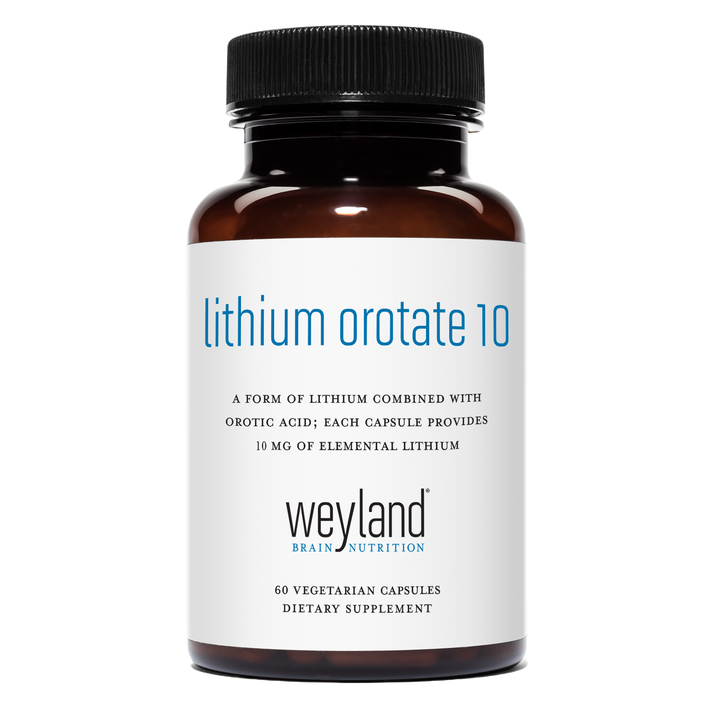
What Is Lithium Orotate and How Does It Work?
Lithium orotate is a dietary supplement that binds elemental lithium to orotic acid. This combination is used in low-dose lithium supplements and is often discussed in the context of brain health support. Understanding the basic mechanics of this compound helps explain why it is gaining so much popularity today.
Orotic acid serves as the carrier molecule within the supplement. Researchers continue to study how different lithium forms are absorbed and how they may influence cellular signaling at trace levels.
Unlike prescription lithium carbonate, lithium orotate provides microdoses of the mineral and is available over the counter. Prescription lithium is used under medical supervision to manage conditions such as bipolar disorder, and dosing is much higher than what is found in dietary supplements. Many people explore low-dose lithium supplementation for proactive brain health and mood support rather than for treatment of acute mental health issues.
How Does Lithium Orotate Support Mood and Emotional Balance?
When work and life stress pile up, emotions can feel harder to manage. Lithium is being studied for its role in neurotransmitter systems involved in mood regulation and stress signaling. Some people explore lithium orotate as a low-dose supplement option for daily mood support.
Research is ongoing on how lithium may relate to stress response and sleep regulation. Sleep quality also plays a key role in day-to-day mood and focus, and a healthcare provider can help evaluate whether a supplement fits a broader wellness plan.
Can Lithium Orotate Improve Memory and Cognitive Function?
We all experience days where focus feels low. Forgetting a password or losing a train of thought can happen to anyone. Some studies examining lithium exposure suggest it may interact with pathways involved in synaptic function and memory processes, including brain regions associated with learning.
Research on low-dose lithium supplementation is still in its early stages, and results vary by individual health factors. A healthcare provider can help assess safety, especially for older adults or anyone managing other medical conditions.

How Does Lithium Orotate Promote Long-Term Brain Health?
Protecting brain health over time often includes sleep, nutrition, movement, and stress management. Lithium is being studied for its role in cellular signaling pathways linked to oxidative balance and inflammatory signaling, which may be relevant to brain health.
Some research also examines whether lithium interacts with pathways involved in mitochondrial activity and long-term cellular resilience. Observational studies of trace lithium levels in public drinking water have reported associations with certain health outcomes in large populations, but these findings do not prove cause and effect.
How Does Lithium Actually Change the Brain?
Lithium is studied for its interactions with proteins, enzymes, and cellular pathways involved in brain signaling. Researchers continue to explore how lithium may influence communication between brain cells and how cells respond to everyday stressors. These mechanisms are still being studied in relation to memory and daily focus.
What Is BDNF and Why Does It Matter?
Brain-Derived Neurotrophic Factor (BDNF) is a helpful protein that encourages the growth and survival of healthy neurons. High levels of this protein improve your ability to learn and adapt to new life challenges. Lithium appears to influence pathways associated with BDNF in some research settings, and scientists continue to study how this may relate to brain adaptability over time.
How Does It Interact With the GSK-3β Enzyme?
Glycogen synthase kinase-3 beta (GSK-3β) is an enzyme involved in several cell signaling processes. Lithium has been shown in laboratory research to influence GSK-3β activity, which is one reason scientists study it in relation to neuronal signaling and cellular regulation. More research is needed to understand how these findings translate to dietary supplement use in everyday settings.
Strengthen Memory, Focus, and Brain Function
Fuel cognitive performance and mood stability with Weyland Lithium Orotate 10mg. We guarantee your satisfaction, or we will refund 100% of your purchase.
Start Your Brain SupportWhat Is the Recommended Lithium Orotate Dosage?
The recommended dose typically ranges from 5 to 20 milligrams of elemental lithium per day. Elemental lithium refers strictly to the actual mineral content inside the capsule, not the total weight of the entire supplement compound. You should never assume higher doses work better for your cognitive health.
Some people report mild digestive upset, slight headaches, or increased thirst when starting out. Taking larger doses of lithium requires medical supervision, and a healthcare provider can help evaluate dosing and interactions.
Pregnant individuals and anyone taking prescription lithium or medications such as nonsteroidal anti-inflammatory drugs (NSAIDs) should consult a healthcare provider before considering lithium supplements. Medical guidance is important for safety, especially when other medications or medical conditions are involved.
How Can You Add Lithium Orotate to a Brain Health Plan?
Adding lithium orotate to a routine may work best when paired with healthy lifestyle habits that support brain health. Nutrition, sleep, movement, and stress management can complement low-dose supplements in long-term wellness.
Nutrition that supports brain health includes eating diets rich in healthy fats and essential minerals. Omega-3 fatty acids, magnesium, and abundant antioxidants can support overall brain health and cellular function. Adding these nutrients through whole foods or food fortification can support a balanced approach alongside other supplements.
Lifestyle habits that enhance results involve regular physical activity and deep, restorative sleep. Exercise increases blood flow to the brain, while sleep supports memory, focus, and recovery. Many people aim for routines that support clarity, balance, and long-term wellness.
Give Your Brain the Support It Deserves
Boost mental clarity, support emotional balance, and reinforce long-term brain wellness with Weyland Lithium Orotate 10mg.
Buy Lithium Orotate 10mgFrequently Asked Questions
What does lithium orotate do for the brain?
Lithium orotate supports brain health by promoting a balanced neurotransmitter profile, encouraging new cell growth, and interacting with cellular pathways involved in oxidative balance.
Is lithium orotate safe to take daily?
Evidence from several observational studies exploring trace lithium exposure suggests low dose lithium supplements may be tolerated when used appropriately. A healthcare provider should be consulted before daily use.
How long does it take to notice lithium orotate benefits?
Research on low-dose lithium supplementation is ongoing, and timelines for noticeable effects may vary based on individual health factors.
Can lithium orotate help with memory loss?
Evidence supporting low-dose lithium suggests it may interact with pathways involved in memory and neuronal maintenance.
What is the difference between lithium orotate and lithium carbonate?
Unlike prescription lithium carbonate used to treat bipolar disorder at high doses, lithium orotate offers trace amounts of elemental lithium primarily as an over-the-counter dietary supplement for general brain resilience.
References
- Dwivedi, T., & Zhang, H. (2015). Lithium-induced neuroprotection is associated with epigenetic modification of specific BDNF gene promoter and altered expression of apoptotic-regulatory proteins. Frontiers in neuroscience, 8, 457. https://doi.org/10.3389/fnins.2014.00457
- Jope R. S. (2003). Lithium and GSK-3: one inhibitor, two inhibitory actions, multiple outcomes. Trends in pharmacological sciences, 24(9), 441–443. https://doi.org/10.1016/S0165-6147(03)00206-2
- Machado-Vieira, R., Manji, H. K., & Zarate, C. A., Jr (2009). The role of lithium in the treatment of bipolar disorder: convergent evidence for neurotrophic effects as a unifying hypothesis. Bipolar disorders, 11 Suppl 2(Suppl 2), 92–109. https://doi.org/10.1111/j.1399-5618.2009.00714.x
- Terao T. (2015). Is lithium potentially a trace element?. World journal of psychiatry, 5(1), 1–3. https://doi.org/10.5498/wjp.v5.i1.1
- U.S. Food and Drug Administration. (2011). Lithium carbonate tablets USP, lithium carbonate tablets USP, lithium carbonate capsules USP, lithium oral solution USP. https://www.accessdata.fda.gov/drugsatfda_docs/label/2011/017812s028,018421s027lbl.pdf
About our sourcing: Our lithium orotate active ingredient is sourced from a European EU supplier. We purposely source more ingredients from Europe, where food safety regulations are stricter and more stringent than in many other supplement-ingredient origin countries.
Medical Disclaimer
The content on this page is for informational purposes only and is not intended as medical advice, diagnosis, or treatment. Always consult a qualified healthcare professional before making changes to your health regimen.
*These statements have not been evaluated by the Food and Drug Administration. Our products are not intended to diagnose, treat, cure, or prevent any disease.