Posted by GC Support
on May 15, 2026

Table of Contents
Ask ten people what lithium is, and nine will say "the bipolar medication." The tenth might know it's also a trace element that appears in small amounts in tap water, walnuts, and root vegetables. Average daily intake from food and water ranges from 0.5 to 3 mg, spanning entire continents. Two households eating roughly the same meal plan, one in the Andes and one in Florida, can end up with lithium intakes that look nothing alike on paper.
That spread is part of why a lithium food supplement has crept into more conversations about brain health and overall health over the past few years. Weyland Brain Nutrition makes low-dose lithium supplements for the kind of reader who studies the research and the label before adding anything new.
A Small Daily Top-Up for What Diet and Water May Miss
Weyland's lithium range starts at 1,000 mcg and steps up to 20 mg, so the serving can match what regional soil and tap water already provide instead of overshooting.
See the Low-Dose Range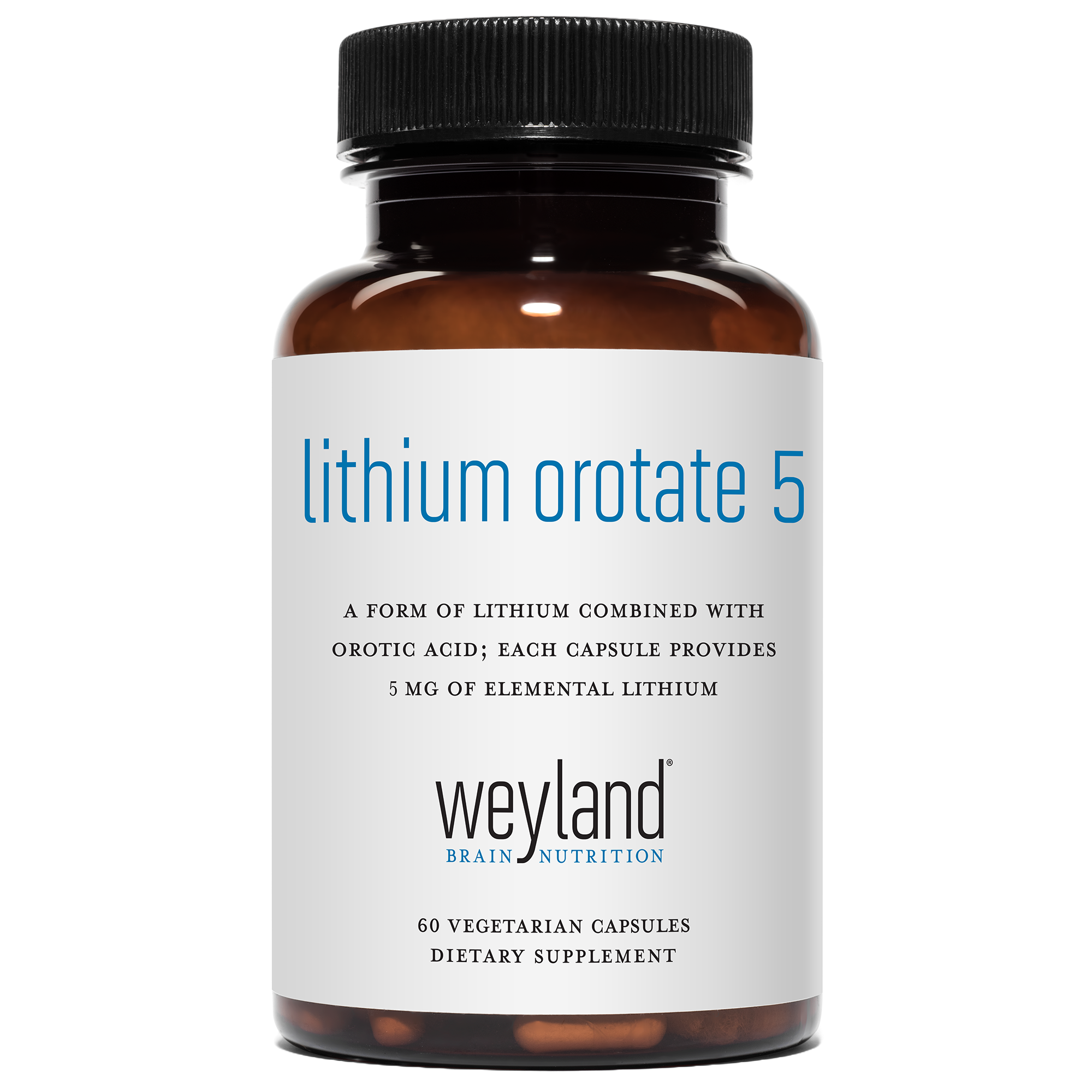
What Is a Lithium Food Supplement?
A lithium food supplement delivers, in a capsule or a few liquid drops, the same trace mineral already present in grains, vegetables, nuts, and drinking water. Most labels list amounts in mcg or low single-digit milligrams, well under any prescription dose.
Nutritional Form of a Trace Mineral
Lithium is a naturally occurring element on the periodic table, and the World Health Organization includes it on the list of nutritionally relevant trace elements. The supplement form, whether lithium orotate, lithium aspartate, or another low-dose nutritional supplement, sits closer to dietary intake than to medication.
Different from Prescription Lithium
Prescription lithium, most often lithium carbonate, is an FDA (Food and Drug Administration)-approved medication used in clinical research and psychiatric care at doses in the hundreds of milligrams. A lithium food supplement is a dietary supplement at low doses, not a substitute for prescription lithium or any medication.

Why Does Dietary Lithium Vary So Much?
Lithium is one of the most location-dependent nutrients in the human diet. Two people on the exact same meal plan can end up with very different lithium levels depending on where the produce was grown and what kind of water filled the glass.
Geography of Soil and Water
Lithium content in produce reflects the mineral profile of the soil where the food is grown. Drinking water carries a similar spread, with public-supply wells in the United States ranging from less than 1 mcg per liter to nearly 400 mcg per liter, depending on the region.
Food Choices and Regional Diets
Diets centered on whole grains, legumes, nuts, leafy greens, and root vegetables tend to deliver more dietary lithium than diets built mostly on processed or refined products. Regional eating patterns shape lithium levels long before any supplemental lithium enters the picture.
Modern Agricultural and Processing Practices
Modern farming, hydroponic growing, and heavy food processing each change the mineral profile of what reaches the plate. Lithium content in produce varies by where and how the food is grown, and food fortification programs in the United States do not currently include lithium.
Start at 1,000 mcg. Adjust From There
Weyland's lowest serving sits at 1,000 mcg, close to the upper end of typical dietary intake, so the routine starts where the diet leaves off. Third-party tested, USA-made.
Browse Serving Sizes
What Are the Signs of Lower Dietary Lithium Intake?
The clearest signs of lower dietary lithium intake show up in the environment and routine, not in how someone feels day to day. A few everyday factors point to a diet and environment that likely deliver less lithium than average:
-
Living in a region with low-lithium groundwater or municipal water
-
Drinking primarily reverse-osmosis filtered or distilled water
-
Eating a diet low in whole grains, legumes, nuts, and root vegetables
-
Relying heavily on processed or refined foods
-
Following a strict low-carb or low-grain eating pattern
-
Living somewhere with documented low-lithium soil, such as parts of the eastern United States
-
Consuming mostly imported or hydroponically grown produce, where local soil mineral content does not apply
Who Tends to Consider a Lithium Food Supplement?
A lithium food supplement gets the most attention from adults thinking about brain wellness, low-water-mineral areas, and trace mineral research. The reasoning behind the choice usually has more to do with closing a dietary gap than chasing a specific outcome.
People Focused on Brain Wellness
Adults working on healthy brain aging often look at low-dose lithium supplementation alongside sleep, exercise, and nutrient-dense eating. The interest aligns with ongoing research on lithium and cognitive function, including work on healthy brain aging and the role of trace minerals in cellular processes.
Adults in Low-Lithium Water Regions
People living in areas with documented low lithium in drinking water sometimes add a low-dose form to match what others get from local groundwater. Weyland's lithium range spans 1,000 mcg, 2.5 mg, 5 mg, 10 mg, and 20 mg options, plus liquid drops, so different routines can be matched without overshooting.
Readers Following Trace Mineral Research
A growing group of readers follows systematic review work on lithium as a trace mineral, including studies in nutrition and brain health journals. The interest tends to be informational first, supplemental second.

How Do You Add Nutritional Lithium Sensibly?
Building a routine around dietary lithium does not have to be complicated. A few simple habits help build a routine around dietary lithium without overcomplicating things:
-
Eat a variety of whole grains, legumes, nuts, leafy greens, and root vegetables
-
Check the local water report for trace mineral content, including lithium
-
Start at the lowest serving size if adding a lithium food supplement, then adjust over weeks
-
Pick a third-party tested product made in an FDA-registered, cGMP (current Good Manufacturing Practice)-compliant facility
-
Talk with a qualified healthcare professional before starting, especially when taking prescription medications
-
Track how a routine feels over several weeks rather than judging after a few days
Closing the Lithium Gap Starts With Daily Intake
Dietary lithium swings more than most people realize, shaped by regional soil, the water that comes out of the tap, and what ends up on the plate from one meal to the next. A handful of factors, low-mineral water, processed-heavy diets, and certain geographic areas, point to lower daily exposure than the average. Some readers close that gap with a low-dose nutritional supplement, layered on top of a wider whole-foods routine.
Explore Weyland's lithium range across 1,000 mcg, 2.5 mg, 5 mg, 10 mg, and 20 mg capsules and liquid drops, compare the formats, and start small with the serving size that fits a routine.
Close the Dietary Gap, on Your Terms
From 1,000 mcg capsules to liquid drops and the 5 mg formula with magnesium and vitamin E, Weyland's lithium range fits the routine instead of forcing one.
Shop the Lithium Range
Frequently Asked Questions
What foods are highest in lithium?
Whole grains, nuts such as walnuts and cashews, legumes, leafy greens, and root vegetables tend to provide the most dietary lithium, though intake varies depending on where the food is grown.
How much lithium do you get from food each day?
Researchers have proposed an average daily dietary intake of roughly 0.5 to 3 mg of lithium from food and water combined, depending on region and diet.
Is lithium an essential nutrient?
Lithium is included on the World Health Organization's list of nutritionally relevant trace elements, though no official Recommended Dietary Allowance has been set.
Does drinking water contain lithium?
Yes, drinking water naturally contains trace amounts of lithium, with concentrations ranging from below 1 mcg per liter to several hundred mcg per liter depending on groundwater geology.
Do you need a lithium supplement if you eat a balanced diet?
Most people get measurable lithium from food and water, though evidence suggests that diet, geography, and water source can leave intake noticeably lower for some adults.
References
-
U.S. Food and Drug Administration. (2024, April 24). Current good manufacturing practices (CGMPs) for food and dietary supplements. https://www.fda.gov/food/guidance-regulation-food-and-dietary-supplements/current-good-manufacturing-practices-cgmps-food-and-dietary-supplements
-
U.S. Geological Survey. (2021, February 11). Many Americans may be drinking groundwater with high levels of lithium. https://www.usgs.gov/news/lithium-us-groundwater
-
World Health Organization, International Atomic Energy Agency, & Food and Agriculture Organization of the United Nations. (1996). Trace elements in human nutrition and health. World Health Organization. https://iris.who.int/handle/10665/37931
Medical Disclaimer
The content on this page is for informational purposes only and is not intended as medical advice, diagnosis, or treatment. Always consult a qualified healthcare professional before making changes to your health regimen.
*These statements have not been evaluated by the Food and Drug Administration. Our products are not intended to diagnose, treat, cure, or prevent any disease.