Posted by GC Support
on September 04, 2026

Table of Contents
Most people know lithium as the stuff inside rechargeable batteries or a medication for mood. Here is the part that surprises them: the brain holds tiny, natural amounts of lithium every single day. The connection between lithium and Alzheimer's has become a hot research question, and scientists are now asking whether those trace amounts help keep aging brains sharp. The answer is far from settled, but the early clues are worth understanding.
At Weyland Brain Nutrition, the science behind brain-supporting nutrients gets broken down in plain language, so following along takes no medical degree.
Curious How Nutrients Support the Aging Brain?
Weyland Brain Nutrition breaks the science down in plain language, so you can decide what fits your routine.
Explore the Collection
What Is Lithium's Role in the Brain?
Lithium works in the brain as a naturally occurring trace element, present in amounts far smaller than any medication. The body takes it in through food and water, and researchers study how it may interact with normal brain cell activity. A few basics explain where it comes from and what it does.
A Natural Trace Element
Lithium shows up in the body in tiny, naturally occurring amounts. This endogenous lithium is separate from the higher, prescription doses of lithium used as medicine. Levels of lithium in the brain are measured in trace units, not the amounts found in a pharmacy bottle.
A Role in Cell Signaling
Scientists study lithium for how it may support normal brain cell activity and signaling. Some work looks at molecular targets tied to cognitive function, along with gene expression in brain tissue. That research focuses on normal function, not on any claim that lithium fixes a disease.
Found in Food and Water
Small amounts of lithium reach the body through everyday sources. Some vegetables, whole grains, and drinking water carry naturally occurring lithium, though the amount changes from place to place. Diet and the local water supply both play a part.

What Did the 2025 Alzheimer's Study Find?
A 2025 study found that people with Alzheimer's tend to have lower levels of lithium in a key part of the brain. The research put a fresh spotlight on the link between lithium and Alzheimer's disease. It came from Harvard Medical School and appeared in the journal Nature in August 2025, where the team compared human brain samples from study participants with and without the disease.
Here is what the study reported:
-
Lithium levels were significantly lower in the prefrontal cortex of people with mild cognitive impairment (MCI), an early stage of memory trouble, and Alzheimer's. The researchers called the drop statistically significant.
-
In the brain, lithium appeared to get trapped, or sequestered, by amyloid plaques, the clumps of amyloid β protein that build up in Alzheimer's.
-
In mouse models, a lithium-deficient diet worsened Alzheimer's-related changes, including more amyloid plaques, tau pathology, and synapse loss.
-
The team then tried lithium orotate, a form with reduced amyloid binding, as a kind of replacement therapy. In these AD mouse models and in aging wild-type mice, it helped prevent pathological changes, reduce amyloid plaques, and improve memory in the animals.
-
Findings came from human brain samples and animal models, so a human clinical trial is still needed.
Keep one thing front and center: these results are early. In preclinical models, low-dose lithium was also tied to less brain inflammation, seen as a decrease in neuroinflammation and microglial activation, along with lower tau phosphorylation. Still, that points to a possible connection, not proof that lithium prevents or treats Alzheimer's in people.
What Does "Lithium Deficiency" Mean?
Lithium deficiency is a research idea, not an official medical diagnosis. The phrase sounds clinical, yet it means something specific and limited. A closer look clears up the confusion.
Not an Official Diagnosis
Doctors do not diagnose lithium deficiency the way they test for low iron or low vitamin D. There is no standard blood test or cutoff for it. For now, it describes a pattern seen in research on the brain, aging, and dementia.
Trace Levels vs. Prescription Doses
The amounts studied here sit far below the doses used in medicine. Prescription lithium, such as lithium carbonate, comes in high, carefully monitored doses for conditions like bipolar disorder, where it works as one of several mood stabilizers. The trace lithium in food and water is a different scale entirely.
Why the Difference Matters
Mixing up trace lithium and prescription lithium leads to real confusion about safety. High doses of lithium require blood tests and medical oversight because of the risk of serious side effects. Low, naturally occurring amounts are a separate topic, and treating the two as the same sets up wrong expectations.
Everyday Support for Your Brain Nutrition
Weyland formulates low-dose, trace-mineral supplements made for a simple daily wellness routine.
Shop Brain Support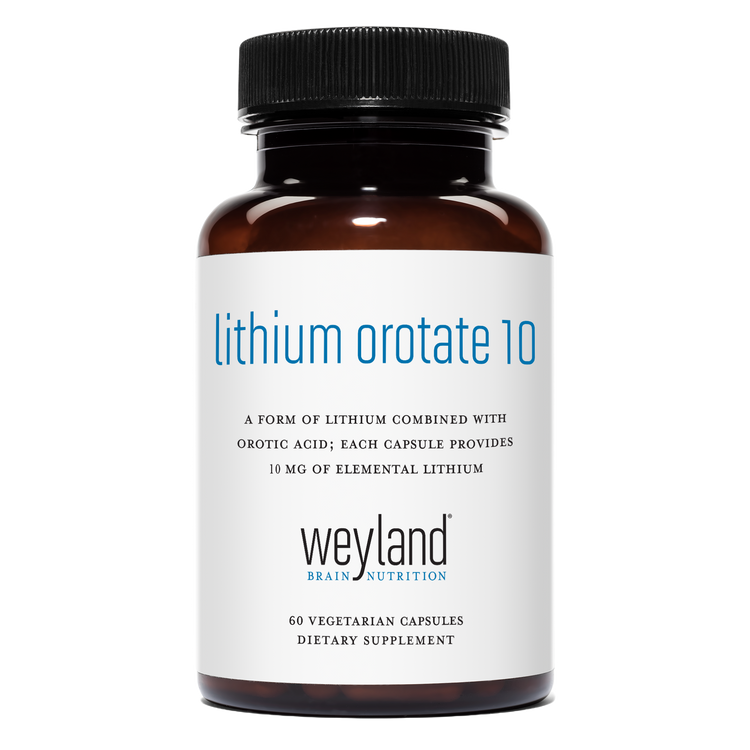
How Does Lithium Orotate Fit In?
Lithium orotate is the low-dose form that showed up in the 2025 research and sits on many supplement shelves. It pairs lithium with orotic acid and delivers only a small, trace amount of the mineral. Here is how it compares to the prescription version and where the science stands.
A Low-Dose, Trace Form
Lithium orotate is a low-dose supplement studied for how it may support normal brain function. It provides trace amounts of lithium, not the high levels used in medication. Many people use it as part of a wider wellness routine.
Not the Same as Prescription Lithium
Lithium orotate and prescription lithium differ in dose, purpose, and oversight. Lithium comes in several forms, or lithium salts, and orotate is one of the gentler, low-dose options among other lithium salts. Carbonate and other mood stabilizers are monitored medications for mood disorders, taken in far higher amounts.
Still Being Studied
Human research on low-dose lithium orotate is still in progress. A planned clinical trial at Johns Hopkins aims to test lithium orotate in older adults, and epidemiological studies keep exploring lithium exposure from drinking water and whether it plays any role in cognitive decline. Larger trials are still needed to understand efficacy and safety, including any risk of toxicity at higher doses, and whether lithium affects disease progression. Conclusions are not final yet.
This statement has not been evaluated by the Food and Drug Administration. This product is not intended to diagnose, treat, cure, or prevent any disease.

How Can You Support Healthy Lithium Intake?
You can support a balanced intake of trace lithium through simple, everyday habits. Everyday lithium use through diet and water is a normal part of life, and none of these steps is a cure or a fix.
Small choices can support a steady intake of this trace mineral:
-
Eat a varied diet with vegetables, whole grains, and legumes.
-
Stay aware that some drinking water naturally contains trace lithium.
-
Consider a low-dose supplement, such as lithium orotate, if a broader wellness routine calls for it.
-
Talk with a healthcare provider before starting any new supplement, especially alongside other medications.
Want to Support Your Brain Naturally?
The link between lithium and Alzheimer's is a promising research story, not a finished one. Low brain lithium may play a role in memory and age-related decline, but the strongest evidence still comes from mouse models and human brain samples, not large human trials. Smart curiosity beats hype here. Read the studies, ask a healthcare provider what fits your situation, and keep learning before making changes.
Weyland Brain Nutrition is a good place to explore the science behind brain-supporting nutrients and decide what belongs in your routine.
Ready to Build a Smarter Routine?
Browse Weyland's full range of brain-supporting nutrients and find what fits your goals.
Browse All Products
Frequently Asked Questions
Does lithium help prevent Alzheimer's?
Early research, mostly in animals and brain tissue, is exploring a possible link, but nothing is proven in people yet.
Is lithium orotate the same as prescription lithium?
No, lithium orotate is a low-dose supplement, while prescription lithium uses much higher, medically monitored doses for different purposes.
Can low lithium levels affect memory?
Researchers are studying whether trace lithium plays a role in memory and aging, though a clear cause-and-effect answer has not been established.
What foods contain lithium?
Small amounts appear in some vegetables, grains, legumes, and certain drinking water, though levels vary by region and diet.
Is lithium orotate safe to take every day?
Many people use it as a low-dose supplement, but daily use is best discussed with a healthcare provider, especially for anyone taking medication.
References
-
Aron, L., Ngian, Z. K., Qiu, C., Choi, J., Liang, M., Drake, D. M., Hamplova, S. E., Lacey, E. K., Roche, P., Yuan, M., Hazaveh, S. S., Lee, E. A., Bennett, D. A., & Yankner, B. A. (2025). Lithium deficiency and the onset of Alzheimer's disease. Nature, 645(8081), 712–721. https://doi.org/10.1038/s41586-025-09335-x
-
Fraiha-Pegado, J., de Paula, V. J. R., Alotaibi, T., Forlenza, O., & Hajek, T. (2024). Trace lithium levels in drinking water and risk of dementia: a systematic review. International journal of bipolar disorders, 12(1), 32. https://doi.org/10.1186/s40345-024-00348-5
-
Hopkins, H. S., & Gelenberg, A. J. (2000). Serum lithium levels and the outcome of maintenance therapy of bipolar disorder. Bipolar disorders, 2(3 Pt 1), 174–179. https://doi.org/10.1034/j.1399-5618.2000.020304.x
-
Kessing, L. V., Gerds, T. A., Knudsen, N. N., Jørgensen, L. F., Kristiansen, S. M., Voutchkova, D., Ernstsen, V., Schullehner, J., Hansen, B., Andersen, P. K., & Ersbøll, A. K. (2017). Association of Lithium in Drinking Water With the Incidence of Dementia. JAMA psychiatry, 74(10), 1005–1010. https://doi.org/10.1001/jamapsychiatry.2017.2362
Medical Disclaimer
The content on this page is for informational purposes only and is not intended as medical advice, diagnosis, or treatment. Always consult a qualified healthcare professional before making changes to your health regimen.
*These statements have not been evaluated by the Food and Drug Administration. Our products are not intended to diagnose, treat, cure, or prevent any disease.