Posted by GC Support
on November 04, 2026

Table of Contents
In 1949, Australian psychiatrist John Cade gave lithium salts to patients with severe mania and watched the psychotic excitement fade. Today, the lithium mood stabilizer is a first-line bipolar disorder treatment, even though researchers are still mapping how it works.
At Weyland Brain Nutrition, we dig into lithium research so it's easier to follow. The science below covers prescription lithium and is for education, not medical advice. Lithium acts on several brain systems at once, and those effects explain both its benefits and its need for regular blood tests.
Looking for Clean, Everyday Brain Nutrition?
While prescription medications require careful medical supervision, Weyland Brain Nutrition crafts targeted wellness supplements designed to support your daily focus and routine with transparent ingredient labels.
Explore Weyland Supplements
What Makes Lithium a Mood Stabilizer?
Lithium counts as a mood stabilizer because it softens both manic highs and depressive lows and lowers the chance of new episodes over time. It also stands apart from most drugs used to treat mental illness in one surprising way.
A Simple Element, Not a Complex Drug
Lithium is element number 3 on the periodic table, the same metal used in batteries. Small amounts of lithium present in soil, water, and food reach the body every day.
In medicine, the lithium ion does the work. The body handles it much like sodium, so the kidneys clear it, and changes in salt or water affect how much stays in the blood.
Lithium salts first entered medicine in the 1800s as a gout remedy, because lithium dissolved uric acid in lab tests. Some doctors also tied low moods to a "uric acid diathesis," and Cade was studying uric acid in manic illness when he noticed lithium's calming effect.
Lithium Carbonate, the Prescription Form
Lithium carbonate is the form of lithium prescribed most often, as tablets or lithium capsules. Lithium citrate is a liquid form, sold in the U.K. under brand names such as Li-Liquid.
The U.S. Food and Drug Administration (FDA) didn’t approve lithium until 1970, partly because lithium salt substitutes caused toxic effects and deaths in the late 1940s. A 300 mg tablet of lithium carbonate contains about 56 mg of elemental lithium.
Low-Dose Supplements: Not a Mood Stabilizer
Over-the-counter low-dose lithium supplements contain far less elemental lithium per serving and are not approved to treat any condition. The brain research described here involves prescription doses.
Adults exploring low-dose lithium for general wellness can browse Weyland’s lithium orotate supplements, ideally after a healthcare provider approves any new supplement. These products are not intended to diagnose, treat, cure, or prevent any disease.

What Does Lithium Do in the Brain?
Lithium calms overactive brain cells and steadies the body's daily clock, though no one knows its exact mechanism yet. The strongest evidence points to several effects of lithium in the central nervous system working at once.
A Brake on Overactive Cell Signals
Lithium blocks an enzyme that recycles inositol, a building block in one of the cell's messaging systems. Think of a brake that grabs harder the faster a car goes.
The busiest cells run low on inositol first. That may explain how lithium quiets overactive signaling without shutting down normal activity.
A Check on the GSK-3 Enzyme
Glycogen synthase kinase-3 (GSK-3) is a busy enzyme tied to mood, sleep timing, and cell survival. Some research links too much GSK-3 activity to mood disorders.
Lithium turns GSK-3 down like a dimmer switch. It blocks the enzyme directly and also triggers signals that switch it off.
Better Balance of Brain Chemicals
Glutamate works like the brain's gas pedal, and gamma-aminobutyric acid (GABA) works like the brake. Mania may involve a gas pedal that sticks.
Lithium appears to ease excess glutamate and dopamine activity, both linked to mania. It also appears to support GABA, so the brain revs less easily.
A Steadier Body Clock
Bipolar disorder is closely tied to disrupted sleep-wake cycles, and a few short nights can tip some people into mania. GSK-3 helps run the body's clock genes, which act like a timer that resets every day.
In lab studies, lithium shifts and steadies that timer. Researchers think a steadier clock is one way lithium may keep sleep and mood on track.
Support for Nerve Cell Growth
Lithium raises levels of brain-derived neurotrophic factor (BDNF), a protein that works like fertilizer for brain cells. Some imaging studies find larger gray matter volume in people on long-term lithium treatment.
Discover Transparent, High-Standard Formulas
Every Weyland product is manufactured in cGMP-compliant facilities with exact ingredient amounts clearly stated on the label, helping you navigate your wellness choices with complete confidence.
Browse All Products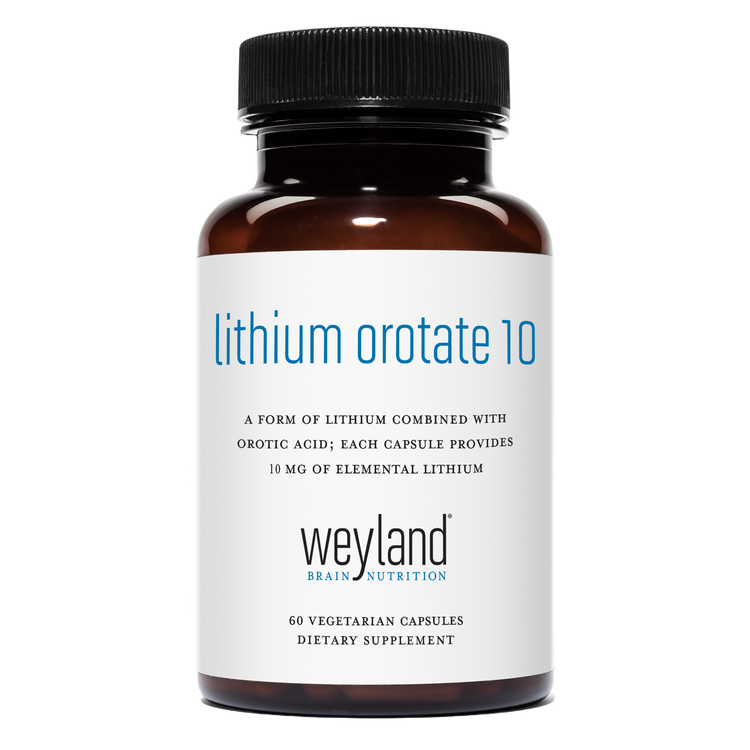
Why Does Lithium Work for Bipolar Disorder?
Lithium works for bipolar disorder because its brain effects add up to three results doctors can measure, each on a different timeline. Some research suggests lithium may work best for people with classic manic episodes and a family history of bipolar disorder.
Relief from Acute Mania
Lithium starts treating mania within one to three weeks for most manic patients, though full control can take several weeks. Because lithium is slow to start, doctors in clinical practice often pair it with an antipsychotic early on.
Fewer Episodes with Long-Term Use
Daily long-term treatment lowers the risk of relapse, and the effect is strongest against manic episodes. Lithium therapy also cuts depressive episodes, though less reliably.
Lower Suicide Risk
Among mood stabilizers, lithium has the strongest evidence for suicide prevention. A 2013 systematic review in the British Medical Journal (BMJ) found that it lowered suicide risk in people with mood disorders, and the authors noted that lithium may also reduce impulsive and aggressive behaviors.
Ecological studies compare whole regions instead of individual people. A 2020 review of 15 such studies in the British Journal of Psychiatry (Br J Psychiatry) linked higher natural lithium in drinking water to lower suicide rates.
This design can't prove causation. The finding hints at the potential utility of trace amounts for future research, and it is no reason to start lithium on your own.

Is Lithium Used for Major Depressive Disorder?
Lithium is used for major depressive disorder, though in a narrower role than in bipolar disorder. Doctors mainly reach for it when standard depression treatment stalls.
An Add-On When Antidepressants Fall Short
Doctors may add lithium when an antidepressant alone isn't helping enough, a step called lithium augmentation. In clinical psychiatry, lithium augmentation has a long track record, and a review of lithium in unipolar depression describes it as an effective add-on for depression that hasn't responded to antidepressants.
An Off-Label Use in the US
FDA approval for lithium covers bipolar disorder only. Using it for depression or other mental health conditions is off-label, which means a doctor prescribes it for a use the label doesn't list.
Why Does Lithium Need Blood Tests?
Lithium needs blood tests because the gap between therapeutic levels and toxic levels is narrow. The kidneys treat lithium much like sodium, so anything that shifts the body's salt or water balance can push lithium concentrations too high.
Everyday Triggers That Raise Levels
Small changes in daily life can tip that balance. Common things that raise lithium levels include:
-
Dehydration from hot weather, heavy sweating, hot baths, or not drinking enough
-
Vomiting, diarrhea, or fever
-
A sudden drop in salt intake
-
Pain relievers called nonsteroidal anti-inflammatory drugs (NSAIDs), such as ibuprofen and naproxen
-
Some blood pressure medicines, including angiotensin-converting enzyme (ACE) inhibitors and thiazide diuretics
Target Ranges on the FDA Label
The FDA label sets a target of 0.8 to 1.2 milliequivalents per liter (mEq/L) for acute mania and 0.8 to 1.0 mEq/L for maintenance. Levels of 1.5 mEq/L or higher count as toxic, so doctors check blood levels often, along with kidney and thyroid function.
Extra Caution with Age and Other Medicines
Older adults often need lower doses, and summer brings an increased risk of lithium toxicity. Before you add other medications, ask a healthcare professional to check for drug interactions, since some other drugs raise lithium levels without warning.
Warning Signs That Need Medical Attention
Lithium toxicity and allergic reactions both need fast care. Get immediate medical attention for any of these warning signs:
-
Confusion
-
Severe shaking
-
Vomiting
-
Muscle weakness
-
An irregular heartbeat
-
A severe headache with vision changes, which can signal increased pressure inside the skull
-
An unusual or allergic reaction, such as hives or swelling
Tell the prescriber about any past reactions before taking lithium. That history helps the doctor decide whether lithium is a safe choice.
Is Lithium Right for You?
Lithium can be the right choice for many people with bipolar disorder because it works on several brain systems at once, which is part of why it's still a first-line treatment. The right fit depends on weighing its potential benefits against adverse effects and lab work with a psychiatrist or other mental health professional.
If you're considering lithium, bring the questions from this page to that appointment. If you already take it, keep lab visits on schedule and never change a dose alone. In the U.S., call or text 988 for thoughts of suicide. Steady labs and honest check-ins are what let lithium do its job for years.
Support Your Daily Wellness Routine with Weyland
From wellness supplements to specialized brain nutrition formulas available in convenient capsules and liquids, explore our collection designed to support your healthy lifestyle.
Shop the Full Collection
Frequently Asked Questions
Does lithium change your personality?
At the right dose, lithium shouldn't change who you are, so feeling flat or less creative is a reason to ask the prescriber about the dose instead of stopping.
Does lithium increase serotonin?
Lithium appears to boost serotonin activity, which may explain why it helps some antidepressants work better, even though it isn't classed as an antidepressant itself.
Why does lithium make you thirsty?
Lithium makes the kidneys less responsive to a water-saving hormone, so more water leaves as urine and the body asks for more to drink.
How long does lithium stay in your system?
Lithium's half-life is roughly 18 to 36 hours in healthy adults, so most of it clears within about a week of the last dose, though weaker kidneys clear it more slowly.
Is lithium a controlled substance?
Lithium isn't on the Drug Enforcement Administration (DEA) list of controlled substances, though it still needs a prescription because the dose must be monitored closely.
References
-
Abou-Saleh, M. T., Müller-Oerlinghausen, B., & Coppen, A. J. (2017). Lithium in the episode and suicide prophylaxis and in augmenting strategies in patients with unipolar depression. International Journal of Bipolar Disorders, 5(1), Article 11. https://doi.org/10.1186/s40345-017-0080-x
-
Cipriani, A., Hawton, K., Stockton, S., & Geddes, J. R. (2013). Lithium in the prevention of suicide in mood disorders: Updated systematic review and meta-analysis. BMJ, 346, Article f3646. https://doi.org/10.1136/bmj.f3646
-
Memon, A., Rogers, I., Fitzsimmons, S. M. D. D., Carter, B., Strawbridge, R., Hidalgo-Mazzei, D., & Young, A. H. (2020). Association between naturally occurring lithium in drinking water and suicide rates: Systematic review and meta-analysis of ecological studies. The British Journal of Psychiatry, 217(6), 667–678. https://doi.org/10.1192/bjp.2020.128
-
U.S. Food and Drug Administration. (2018). Lithium and lithium carbonate [Package insert]. https://www.accessdata.fda.gov/drugsatfda_docs/label/2018/017812s033,018421s032,018558s027lbl.pdf
-
One source is missing. The lithium mood stabilizer article opens with John Cade’s 1949 study, but there’s no reference for it here. If you want to add it, here’s the likely entry:
-
Cade, J. F. J. (1949). Lithium salts in the treatment of psychotic excitement. Medical Journal of Australia, 2(10), 349–352.
Medical Disclaimer
The content on this page is for informational purposes only and is not intended as medical advice, diagnosis, or treatment. Always consult a qualified healthcare professional before making changes to your health regimen.
*These statements have not been evaluated by the Food and Drug Administration. Our products are not intended to diagnose, treat, cure, or prevent any disease.


