Posted by GC Support
on September 09, 2026

Table of Contents
Ask what a normal lithium level is, and the answer splits in two. One is a number from a lab report, tied to a prescription and tracked by a doctor. The other is a trace amount printed on a supplement bottle. They sound like the same thing, but they live on completely different scales, and mixing them up causes real confusion.
At Weyland Brain Nutrition, the clinical numbers and the low-dose supplement world get sorted out in plain language, so an everyday reader knows which one applies to them.
Confused by the Two Lithium Numbers?
Weyland Brain Nutrition sorts out the clinical and the low-dose supplement world in plain language.
Explore the Collection
What Counts as a Normal Lithium Level?
"Normal" depends entirely on who is asking and why. For a doctor, it means a specific blood measure. For someone reading a supplement label, it means something else entirely. Here is how the term breaks down.
A Clinical Blood Measure
In medicine, a normal lithium level refers to the amount of lithium in the blood of a patient taking prescription lithium, checked by a lab. This test measures serum lithium concentrations from a blood sample. It applies to lithium therapy, not to trace amounts from food or supplements.
Measured in mEq/L
Providers often reference a therapeutic range of roughly 0.6 to 1.2 mEq/L (milliequivalents per liter) for prescription use. The exact target is set case by case, and it can shift with maintenance therapy, age, and other prescribed drugs. A doctor decides where each patient's reference range should sit.
Not a Number for Supplements
This clinical figure is not a goal or a label reference for low-dose supplements. A supplement does not aim for a mEq/L number, and it is not measured that way. The blood range belongs to the world of prescription lithium and its blood levels.

Why Are Lithium Blood Levels Monitored?
Lithium blood levels are monitored because prescription lithium works within a tight band, and staying inside it matters. A little too much can tip into lithium toxicity, so doctors keep a close watch. The reasons come down to a narrow window, regular testing, and steady oversight.
A Narrow Safety Window
The therapeutic range for prescription lithium is small, so a provider tracks lithium concentration closely to keep it where intended. If blood concentrations climb too high, warning signs can occur, such as tremor, slurred speech, muscle weakness, vomiting, diarrhea, or poor coordination. These symptoms belong to prescription lithium, not to trace supplement amounts.
Routine Lab Testing
Regular blood tests let a provider confirm the level and adjust the dose as needed. A lab checks the sample, often alongside electrolytes and creatinine, to watch renal function. Things like dehydration, excessive sweating, low sodium intake, or drugs such as diuretics, ACE inhibitors, and NSAIDs (nonsteroidal anti-inflammatory drugs) can change how the body handles lithium and may call for more frequent monitoring.
Guided by a Provider
This kind of monitoring is part of what makes prescription lithium a supervised medication. A doctor sets the dose, reads the results, and manages any risk. That hands-on oversight is the core difference between a prescribed drug and a supplement.
Looking for a Simple Low-Dose Option?
Weyland's trace-mineral formulas are made for everyday routines, with clear labels and no guesswork.
Shop Brain Support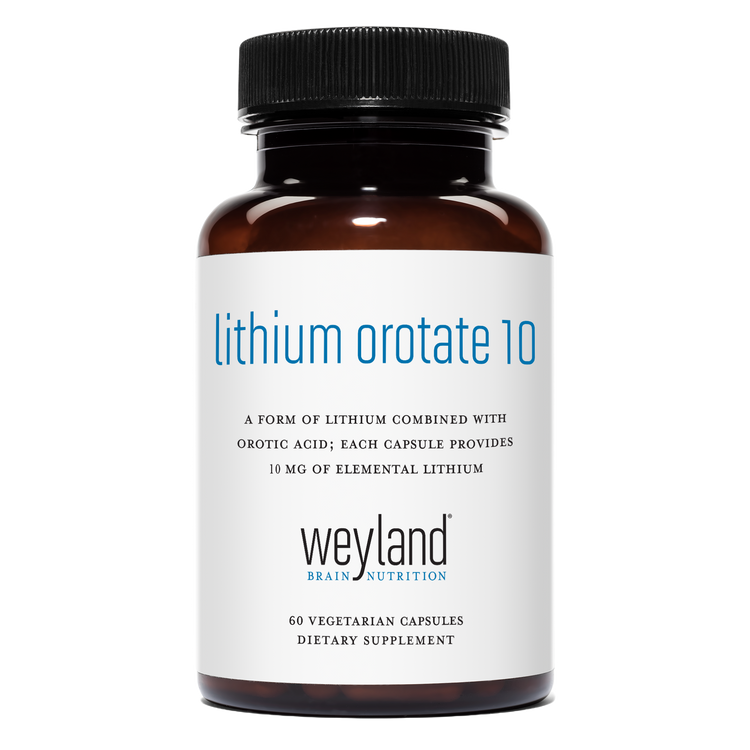
How Do Supplement Doses Compare?
Supplement amounts live on a completely different scale, and seeing them next to clinical levels makes the gap obvious. One is a monitored medication measure, the other a small daily serving.
Here is how clinical levels and supplement doses stack up:
-
Blood levels: a clinical measure in mEq/L, tracked by a provider for prescription lithium.
-
Supplement doses: a low, trace amount printed on the label, taken without lab monitoring.
-
Purpose: one confirms a medication sits in a safe range, the other supports a wellness routine.
-
Scale: the two differ by a wide margin, not a small gap.
-
Oversight: one involves regular testing, the other follows label guidance.
A supplement is not measured against the clinical range, and it is not trying to reach it. These are two separate stories that happen to share a word.

What Is Lithium Orotate's Place in This?
Lithium orotate is the form most people mean when they ask about lithium supplements. It sits firmly in the low-dose world, far from prescription territory. Here is what it is and where it fits.
A Low-Dose, Trace Form
Lithium orotate is a low-dose dietary supplement that supplies trace amounts of lithium. The serving size is small, printed on the label, and taken without blood testing. It is a different scale from the doses used in lithium therapy.
Studied for Brain Support
Lithium orotate is explored for how it may support normal brain function as part of a daily wellness routine. Research on trace, low-dose forms is still developing. Any interest here is about general support, not treating a condition.
Separate from Clinical Levels
Lithium orotate is not designed to reach or reflect a blood-test range. It does not aim for a therapeutic level, and it is not monitored the way prescription lithium is. The two simply do not share the same yardstick.
This statement has not been evaluated by the Food and Drug Administration. This product is not intended to diagnose, treat, cure, or prevent any disease.

How Should You Read Lithium Numbers?
Reading lithium numbers gets easier once the two scales stay in their own lanes. A blood-test range and a supplement serving answer different questions, so it helps to keep them apart.
A few simple habits keep the two from blurring together:
-
Treat blood-test ranges as clinical information tied to prescription use.
-
Read a supplement label for its serving size, not for a mEq/L target.
-
Leave lithium blood testing and its interpretation to a healthcare provider.
-
Ask a provider before starting a supplement, especially alongside other medications.
-
Match any choice to a personal wellness goal rather than a lab number.
Two Scales, One Clear Takeaway: What Now?
A normal lithium level is a clinical blood measure, while supplement doses are a separate, low-dose story, and knowing which one applies is the whole point. If a blood-test range is on the mind, that is a conversation for a healthcare provider. If a low-dose supplement is the interest, start by reading the label and thinking about a real wellness goal.
Weyland Brain Nutrition is a good place to keep learning about low-dose brain nutrients and how they fit into everyday life.
Ready to Explore Low-Dose Brain Nutrients?
Browse Weyland's full range and find the option that fits your everyday wellness goal.
Browse All Products
Frequently Asked Questions
What is a normal lithium level in a blood test?
For people on prescription lithium, providers often reference about 0.6 to 1.2 mEq/L, a clinical range set and monitored case by case rather than a fixed target for everyone.
What lithium level is too high?
Amounts above the intended range can become a concern, which is why prescription lithium involves regular blood tests and provider oversight.
How is a lithium blood test done?
A healthcare provider orders a blood draw, often timed a set number of hours after the last dose, and a lab reports the result.
Do lithium supplements affect your blood levels?
Low-dose forms like lithium orotate add only trace amounts and are not intended to reach the clinical range used for prescription lithium.
Do you need blood tests for lithium orotate?
Routine lithium blood testing is tied to prescription use, though a healthcare provider can advise on what fits any individual supplement routine.
References
-
Hopkins, H. S., & Gelenberg, A. J. (2000). Serum lithium levels and the outcome of maintenance therapy of bipolar disorder. Bipolar disorders, 2(3 Pt 1), 174–179. https://doi.org/10.1034/j.1399-5618.2000.020304.x
-
Quintão, A., & Simião, H. (2021). Lithium intoxication and its implications, pertaining to a clinical case. European Psychiatry, 64(Suppl 1), S624. https://doi.org/10.1192/j.eurpsy.2021.1659
-
Sharma, S., Joshi, S., & Chadda, R. K. (2009). Therapeutic drug monitoring of lithium in patients with bipolar affective disorder: experiences from a tertiary care hospital in India. American journal of therapeutics, 16(5), 393–397. https://doi.org/10.1097/MJT.0b013e31818a88da
-
Shvartsur, R., Agam, G., Shnaider, A., Uzzan, S., Nassar, A., Jabarin, A., Abu-Freha, N., Meir, K., & Azab, A. N. (2021). Safety and Efficacy of Combined Low-Dose Lithium and Low-Dose Aspirin: A Pharmacological and Behavioral Proof-of-Concept Study in Rats. Pharmaceutics, 13(11), 1827. https://doi.org/10.3390/pharmaceutics13111827
Medical Disclaimer
The content on this page is for informational purposes only and is not intended as medical advice, diagnosis, or treatment. Always consult a qualified healthcare professional before making changes to your health regimen.
*These statements have not been evaluated by the Food and Drug Administration. Our products are not intended to diagnose, treat, cure, or prevent any disease.