Posted by GC Support
on September 14, 2026

Table of Contents
Type "lithium pills" into a search bar and two very different products show up. One sits behind a pharmacy counter and needs a doctor's signature. The other rests on a supplement shelf, ready to grab like a bottle of vitamins. They share a name and almost nothing else, and confusing the two leads to real mix-ups about dose, purpose, and safety.
At Weyland Brain Nutrition, everyday readers get help telling low-dose brain nutrients apart from the medical world of prescriptions, minus the confusion.
Curious About Low-Dose Lithium Options?
Prescription lithium and lithium supplements serve very different roles. If you are exploring supplements for a general wellness routine, browse Weyland's options and review the label, serving size, and ingredients before deciding what fits your needs.
Browse Weyland Supplements
Are All Lithium Pills the Same?
No, lithium pills are not all the same, even though they share one word. The label "lithium" hides a wide gap between a prescription medicine and a low-dose supplement. Here is what separates them.
One Name, Two Products
Prescription lithium and over-the-counter lithium supplements share an element but differ in almost every practical way. One is a regulated medication. The other is a dietary supplement sold alongside other over-the-counter medicines.
Dose Is the Big Divider
Dose is the clearest line between the two. Prescription forms use much higher, carefully measured amounts, set and checked by a doctor. Supplements stay in a low, trace range that is a fraction of that size.
Purpose Sets Them Apart
Purpose is the other big divider. One is a medically supervised medication managed by a healthcare professional. The other is a dietary supplement someone chooses for a general wellness routine, and the two serve different roles.

What Is Prescription Lithium?
Prescription lithium is the older, more familiar form, and it lives firmly in the medical world. A common version is lithium carbonate, and another is lithium citrate, taken as lithium tablets or an oral solution. It is a mood stabiliser used in psychiatry for conditions such as bipolar disorder, and it is only available through a doctor.
A Doctor-Supervised Medication
Prescription lithium is a medicine taken under a healthcare provider's supervision, with the dose decided by that provider. A doctor handles prescribing lithium, sets the correct dose, and watches for drug interactions with other medicines, including ACE inhibitors. Following the prescribed dose exactly is part of how the medicine is meant to work.
Requires Regular Monitoring
People on prescription lithium usually get regular blood tests so a provider can keep the amount in a safe range. These blood tests check serum lithium levels, because too much lithium can lead to lithium toxicity. Warning signs of lithium toxicity can include tremor, slurred speech, or muscle weakness, which call for prompt medical attention.
Higher, Measured Doses
The doses in prescription lithium are far larger than anything found in a supplement. That size is exactly why the medicine needs a doctor, regular monitoring, and careful handling. It is a serious medication, not a casual purchase.
Ready to Compare Your Supplement Options?
Now that the difference between prescription lithium and low-dose supplements is clearer, take the same careful approach to product labels. Compare serving information, ingredients, and quality details before adding anything new to your daily routine.
See Weyland's Options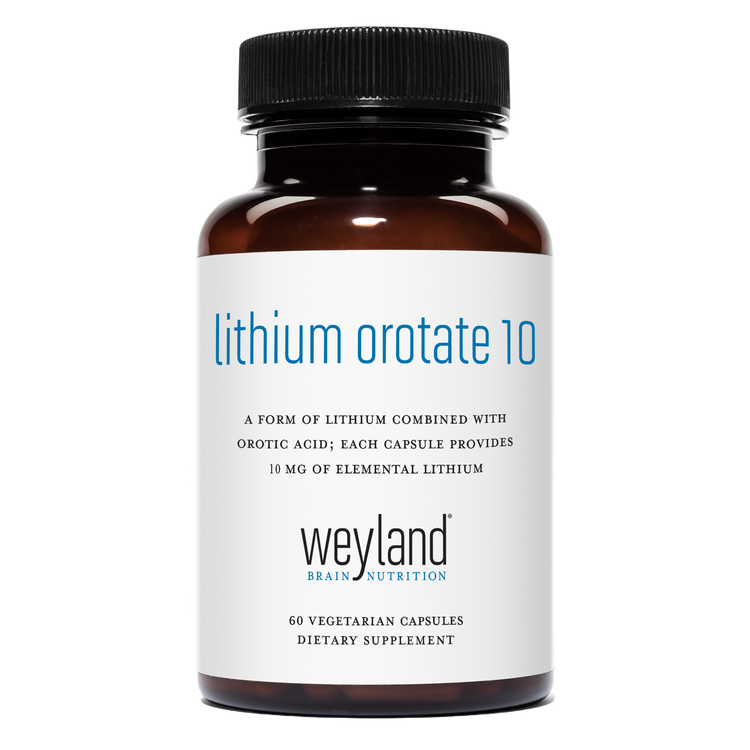
What Are Over-the-Counter Lithium Pills?
Over-the-counter lithium pills are newer to many people and work on a completely different scale. The most common form is lithium orotate, sold without a prescription. Here is what sets the supplement side apart.
A Low-Dose Supplement
Over-the-counter lithium, often lithium orotate, is a low-dose dietary supplement available without a prescription. It delivers only a small, trace amount of lithium. The serving size sits right on the label.
Studied for Brain Support
Lithium orotate is explored for how it may support normal brain function as part of a daily routine. Any interest here is about general support, described in wellness terms. It is not offered as a treatment for a medical condition.
No Prescription Needed
A low-dose lithium supplement can be bought like other supplements, with no prescription required. Label guidance still applies, and reading the suggested serving matters. A healthcare professional can help anyone decide whether it fits a personal routine.
This statement has not been evaluated by the Food and Drug Administration. This product is not intended to diagnose, treat, cure, or prevent any disease.
How Do the Two Compare Side by Side?
Laying the differences next to each other makes the gap easy to see. One is a supervised medication, the other a self-selected supplement, and they line up on a few clear points.
| Factor | Prescription Lithium | Over-the-Counter Lithium |
|---|---|---|
| Access | Needs a prescription | Sold as a supplement |
| Dose | High and measured | Low and trace |
| Oversight | Provider and blood tests | Self-selected |
| Purpose | Medication | Dietary supplement |
| Cost and Setting | From a pharmacy | From a supplement retailer |
These two are not interchangeable, and swapping one for the other is not the intent. They answer different needs and belong in different hands.
Which Option Should You Look Into?
The right option depends on what a person is actually after, so it helps to match the choice to the real goal. A quick gut check keeps the decision grounded rather than driven by a search-bar guess.
A few simple points can steer the decision:
-
Anyone considering prescription lithium should talk with a healthcare provider.
-
Anyone curious about a low-dose supplement can start by reading the label.
-
Never treat an over-the-counter pill as a replacement for a prescribed medication.
-
Loop in a provider if other medications are already in the mix.
-
Match the choice to a personal wellness goal, not to a search-bar guess.
Prescription or Supplement: What Now?
Prescription and over-the-counter lithium pills share a name but differ in dose, purpose, and oversight, and knowing which is which is the whole point. If a medication is the real need, that path runs through a doctor. If a low-dose supplement fits a wellness routine, reading the label is the place to start, and a provider can help anyone weighing other medications.
Weyland Brain Nutrition is a good place to keep learning about low-dose brain nutrients and where they fit in everyday life.
Keep Your Next Step Simple
You now know why prescription lithium and lithium supplements should not be treated as interchangeable. If a low-dose supplement fits your wellness goals, explore Weyland's collection and choose based on clear labeling, serving guidance, and your individual routine.
Explore Weyland Brain Nutrition
Frequently Asked Questions
Can you buy lithium pills over the counter?
Low-dose lithium supplements, such as lithium orotate, are sold without a prescription, while higher-dose lithium medication requires one from a healthcare provider.
Is lithium orotate the same as prescription lithium?
No, lithium orotate is a low-dose dietary supplement, and prescription lithium is a medically supervised medication given in much larger amounts.
Do over-the-counter lithium pills need a prescription?
No, supplement forms can be purchased like other dietary supplements, though following label guidance and checking with a provider is wise.
Are over-the-counter lithium supplements safe?
Many people use low-dose forms as directed, but a healthcare provider can give personalized guidance, especially for anyone taking other medications.
Why is some lithium a prescription and some a supplement?
The difference comes down to dose and purpose, since high, measured amounts are regulated as medication, while trace, low-dose amounts are sold as supplements.
References
-
Hopkins, H. S., & Gelenberg, A. J. (2000). Serum lithium levels and the outcome of maintenance therapy of bipolar disorder. Bipolar disorders, 2(3 Pt 1), 174–179. https://doi.org/10.1034/j.1399-5618.2000.020304.x
-
Pacholko, A. G., & Bekar, L. K. (2023). Different pharmacokinetics of lithium orotate inform why it is more potent, effective, and less toxic than lithium carbonate in a mouse model of mania. Journal of psychiatric research, 164, 192–201. https://doi.org/10.1016/j.jpsychires.2023.06.012
-
Quintão, A., & Simião, H. (2021). Lithium intoxication and its implications, pertaining to a clinical case. European Psychiatry, 64(Suppl 1), S624. https://doi.org/10.1192/j.eurpsy.2021.1659
-
Sharma, S., Joshi, S., & Chadda, R. K. (2009). Therapeutic drug monitoring of lithium in patients with bipolar affective disorder: experiences from a tertiary care hospital in India. American journal of therapeutics, 16(5), 393–397. https://doi.org/10.1097/MJT.0b013e31818a88da
Medical Disclaimer
The content on this page is for informational purposes only and is not intended as medical advice, diagnosis, or treatment. Always consult a qualified healthcare professional before making changes to your health regimen.
*These statements have not been evaluated by the Food and Drug Administration. Our products are not intended to diagnose, treat, cure, or prevent any disease.


