Posted by GC Support
on September 18, 2026

Table of Contents
Search "therapeutic lithium level," and the results fill up with blood tests, milligram-per-liter ranges, and doctor visits. That leaves anyone holding a bottle of lithium orotate with a fair question: where does a supplement land on that scale? The short version is that it sits far below the clinical range, and understanding why clears up a lot of confusion about what a low-dose supplement is and is not.
At Weyland Brain Nutrition, the gap between clinical numbers and low-dose brain nutrients gets explained in plain language, without the medical jargon.
Put Low-Dose Lithium in the Right Perspective
A therapeutic lithium level belongs to prescription care and regular monitoring. If you are exploring lithium as part of a daily wellness routine, compare Weyland's low-dose options and see how they fit on a very different scale.
Explore Low-Dose Options
What Is a Therapeutic Lithium Level?
A therapeutic lithium level is a clinical blood measure, and the phrase comes straight from the medical world. It describes how much lithium is in the blood of a person on prescription lithium, tracked by a doctor. Here is what that means in practice.
A Clinical Blood Measure
A therapeutic lithium level refers to the amount of lithium in the blood of someone taking prescription lithium, checked through lab testing. These serum lithium levels come from a blood draw, and a lab reports the result. The number applies to lithium therapy, not to trace amounts from a supplement.
Measured in mEq/L
Providers often reference a therapeutic range of roughly 0.6 to 1.2 mEq/L (milliequivalents per liter), sometimes written as mmol/L, for prescription use. The exact target sits inside that band and can shift with maintenance therapy. A doctor sets where each person's number should land.
Set and Watched by a Provider
This range applies to supervised medication, with a provider deciding and adjusting the amount. Regular monitoring keeps serum lithium concentrations inside the intended window. That oversight is part of what makes prescription lithium a managed treatment.

Does Lithium Orotate Reach That Level?
No, lithium orotate does not reach a therapeutic lithium level, and this is the question most people arrive with. A low-dose supplement sits far below the prescription range, and that is true by design. Here is the short answer, laid out plainly.
Here is the short answer, laid out plainly:
-
No. Lithium orotate is a low-dose supplement and stays well below the prescription therapeutic range.
-
The amounts differ by a wide margin, not a small one.
-
A supplement serving delivers only a trace amount of lithium, far from clinical dosing.
-
Reaching a therapeutic blood level is not the goal of a low-dose supplement.
-
Anyone who needs that clinical range would be under a provider's care, not relying on a supplement.
This gap is by design, and the two products are not built to do the same job. One is a trace-level supplement, the other a monitored medication.
Why Is the Prescription Range Kept So Narrow?
The prescription range is kept narrow because prescription lithium works within a small safety window, and staying inside it matters. That tight band is exactly why monitoring exists. Here is what that oversight involves.
A Small Safety Window
Prescription lithium works within a narrow band, so providers watch the amount closely. Too little may fall short of the intended therapeutic range, and too much can push toward lithium toxicity, with signs like tremor or slurred speech. That small margin is why lithium is described as having a narrow therapeutic index.
Routine Blood Testing
Regular lab checks help a provider keep the level inside the intended range. Blood tests track serum lithium concentrations, often alongside thyroid function tests and kidney checks. Things like low sodium intake, dehydration, or certain drugs such as ACE inhibitors can shift the number and may call for more frequent monitoring.
Ongoing Provider Oversight
This careful supervision is part of what separates a medication from a supplement. A doctor sets the dose, reads the results, and adjusts as needed. That hands-on management belongs to prescription lithium, not to a trace-level supplement.
Choose a Supplement for Its Intended Purpose
Lithium orotate is not designed to reach the monitored blood levels used with prescription lithium. Weyland's nutritional options are made for everyday wellness, giving you a simple way to compare low-dose choices without confusing them with clinical treatment.
Compare Weyland Supplements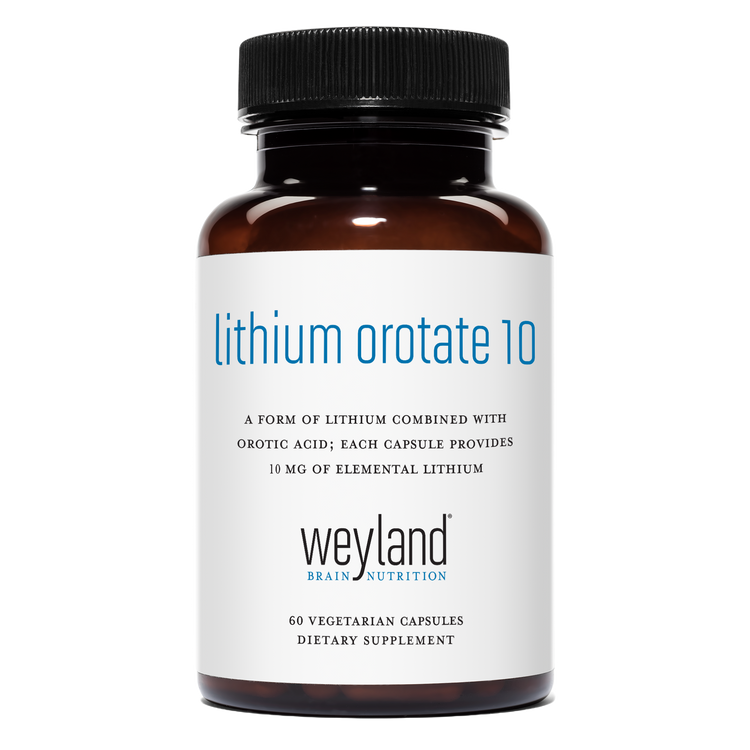
What Does Lithium Orotate Actually Offer?
Lithium orotate offers a low-dose, trace amount of lithium, which serves a different purpose from reaching a clinical number. If it is not aiming for a blood-test level, it helps to understand what the low-dose form is actually for. Here is where it fits.
A Low-Dose, Trace Form
Lithium orotate is a low-dose dietary supplement that supplies trace amounts of lithium. The serving size is small and printed on the label. It works on a completely different scale from prescription lithium.
Studied for Brain Support
Lithium orotate is explored for how it may support normal brain function as part of a daily routine. Any interest here stays in general wellness terms. It is not offered as a treatment for a medical condition.
Not a Substitute for Medication
Lithium orotate is not designed to replace prescription lithium or reach a therapeutic blood level. It does not aim for a clinical number and is not monitored the way medication is. Anyone who needs prescription lithium should stay under a provider's care.
This statement has not been evaluated by the Food and Drug Administration. This product is not intended to diagnose, treat, cure, or prevent any disease.

How Should You Approach Low-Dose Lithium?
Approaching low-dose lithium works best when expectations stay grounded in what a supplement actually is. It is a trace-level product for a wellness routine, not a way to hit a clinical target. A few simple points keep that clear.
A few simple points can keep expectations grounded:
-
Treat lithium orotate as a low-dose supplement, not a stand-in for medication.
-
Follow the label's suggested serving rather than aiming for a blood-test number.
-
Skip the idea of self-managing a therapeutic level, since that belongs with a provider.
-
Loop in a healthcare provider before starting, especially alongside other medications.
-
Match the choice to a broader wellness goal, not to a clinical target.
Different Scales, Different Purposes: What Now?
A therapeutic lithium level is a clinical, monitored measure, and a low-dose supplement sits far below it on purpose. That gap is the whole point, since the two answer different needs. If a clinical range is part of the picture, that is a conversation for a healthcare provider. If a low-dose supplement fits a wellness routine, reading the label is the place to start.
Weyland Brain Nutrition is a good place to keep learning about low-dose brain nutrients and where they fit in everyday life.
Keep Clinical Levels and Daily Wellness Separate
Prescription lithium and lithium orotate work on very different dose scales. If a low-dose nutritional supplement fits your wellness goals, browse Weyland's collection and compare the available options using the serving information on each label.
Browse Weyland's Collection
Frequently Asked Questions
What is the therapeutic range for lithium?
For prescription lithium, providers often reference a blood level of about 0.6 to 1.2 mEq/L, a clinical measure tied to supervised medication rather than supplements.
What lithium level is considered toxic?
Levels above the therapeutic range can become a concern, which is why people on prescription lithium have regular blood tests and provider oversight.
Does lithium orotate raise your blood lithium levels?
It adds only a trace amount, staying well below the clinical therapeutic range used for prescription lithium.
How much lithium is actually in lithium orotate?
Each serving supplies a small, trace amount, and the elemental lithium is only a fraction of the total compound, so exact amounts vary by product.
Do you need blood tests while taking lithium orotate?
Routine lithium blood testing is tied to prescription use, though a healthcare provider can advise on what makes sense for any individual supplement routine.
References
-
Hopkins, H. S., & Gelenberg, A. J. (2000). Serum lithium levels and the outcome of maintenance therapy of bipolar disorder. Bipolar disorders, 2(3 Pt 1), 174–179. https://doi.org/10.1034/j.1399-5618.2000.020304.x
-
Pacholko, A. G., & Bekar, L. K. (2023). Different pharmacokinetics of lithium orotate inform why it is more potent, effective, and less toxic than lithium carbonate in a mouse model of mania. Journal of psychiatric research, 164, 192–201. https://doi.org/10.1016/j.jpsychires.2023.06.012
-
Sharma, S., Joshi, S., & Chadda, R. K. (2009). Therapeutic drug monitoring of lithium in patients with bipolar affective disorder: experiences from a tertiary care hospital in India. American journal of therapeutics, 16(5), 393–397. https://doi.org/10.1097/MJT.0b013e31818a88da
Medical Disclaimer
The content on this page is for informational purposes only and is not intended as medical advice, diagnosis, or treatment. Always consult a qualified healthcare professional before making changes to your health regimen.
*These statements have not been evaluated by the Food and Drug Administration. Our products are not intended to diagnose, treat, cure, or prevent any disease.