Posted by GC Support
on May 18, 2026

Table of Contents
Why does a 5 mg orotate lithium capsule even register on the radar when prescription lithium runs in the hundreds of milligrams? Fair question. The proposed answer points to the orotate molecule itself. Back in the 1970s, a German physician named Hans Nieper theorized that pairing minerals with orotic acid helps deliver them into cells more efficiently than other lithium salts or mineral pairings. The hypothesis stuck around in the supplement world. Rigorous human pharmacokinetic data on lithium orotate have not caught up.
What follows is a plain-language walk-through of what the orotate molecule does, what current research suggests, and where the open questions still sit. Weyland Brain Nutrition makes low-dose lithium supplements for the kind of reader who reads the studies before adding anything new to a routine.
Built for the Reader Who Checks the Science First
Weyland's lithium orotate range covers 1,000 mcg through 20 mg, made in an FDA-registered, cGMP-compliant facility in the USA and third-party tested every batch, so the label matches the capsule.
See the Range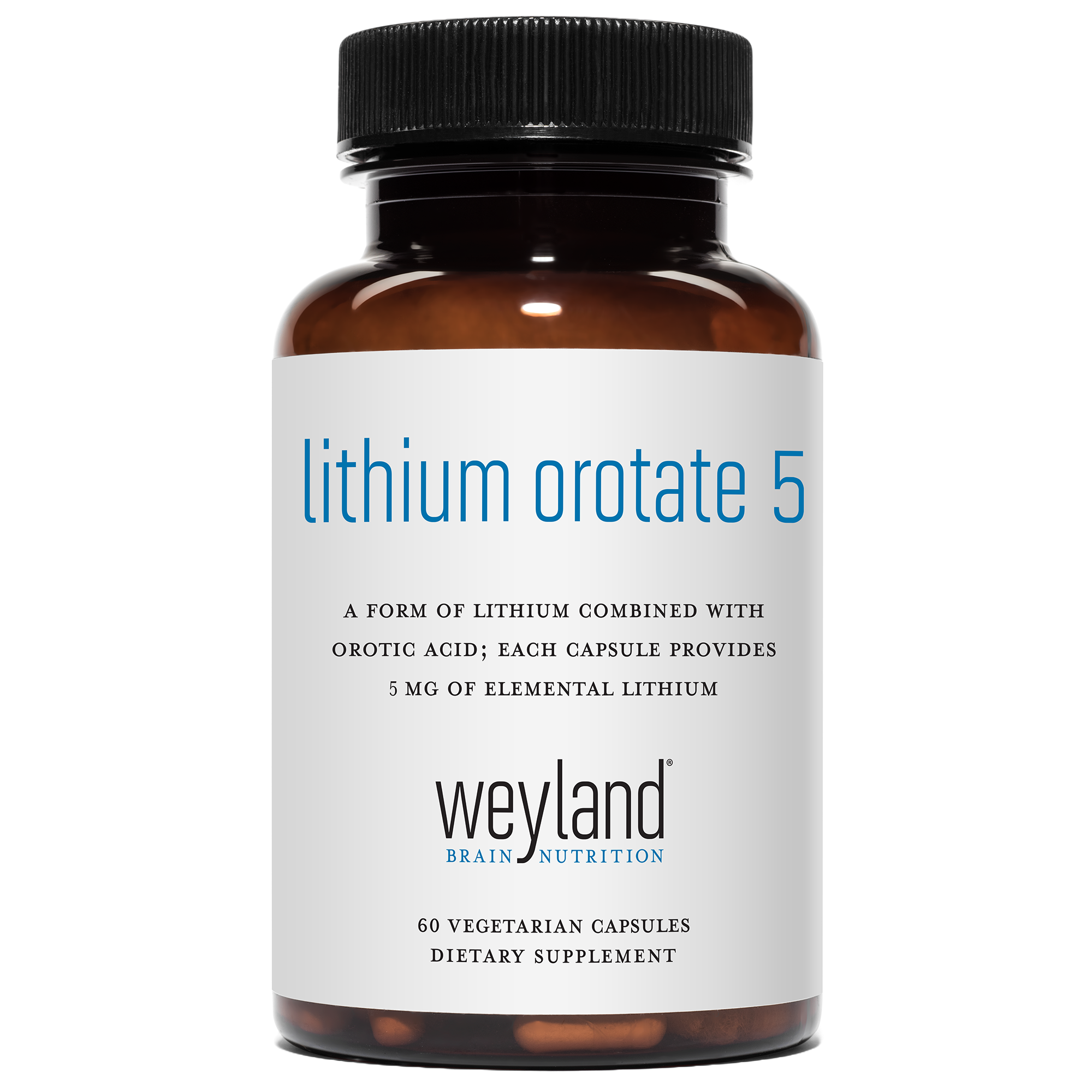
What Is Orotate Lithium?
Orotate lithium is a low-dose nutritional form of lithium bound to orotic acid, a naturally occurring compound the body uses in everyday biology. Most lithium orotate supplement labels list 1,000 mcg to 20 mg of elemental lithium per capsule, well below the doses used in prescription lithium.
Lithium Bound to Orotic Acid
The compound pairs one part lithium with one part orotic acid, sometimes labeled as lithium orotate. The orotic acid component is what the supplement industry has theorized helps deliver lithium more efficiently, though the mechanism remains under investigation.
A Low-Dose Nutritional Form
Orotate lithium falls within the trace mineral category, closer to dietary intake than to medication. Prescription lithium carbonate runs from 600 to 1,800 mg daily under medical supervision, while a low-dose lithium orotate serving sits at a small fraction of that amount.

What Does Orotic Acid Do in the Body?
Orotic acid is not foreign to human biology. The body makes it on its own as part of normal cellular processes, which is why it often appears paired with several minerals in dietary supplements.
Naturally Occurring Compound
Orotic acid was once informally called vitamin B13 in older nutrition literature, though that designation was never officially adopted because the body produces it without dietary intake. It also turns up in small amounts in dairy products and a handful of plant foods.
Role in Pyrimidine Synthesis
Inside the body, orotic acid plays a role in the synthesis of pyrimidines, the building blocks the body uses to construct DNA and RNA. The compound is an intermediate in that pathway, meaning it appears partway through the process rather than at the start or end.
Proposed Mineral Carrier Function
Nieper proposed that orotic acid acts as a carrier for minerals, helping them reach cells more efficiently than ionic salts. The mineral carrier idea remains under investigation, and modern pharmacokinetic studies have not confirmed it as supplement marketing has often implied.
How Might Orotate Help Lithium Reach Neurons?
This is the central question, and the honest answer is mixed. Lithium ions are already known to cross the blood-brain barrier on their own, which complicates any clean claim that orotate is doing the heavy lifting.
Crossing the Blood-Brain Barrier
Lithium ions move across the blood-brain barrier through ion channels that handle other small cations like sodium and potassium. Whether the orotate pairing meaningfully changes that crossing is still being studied, and human data on this specific question is limited.
Cellular Uptake at Low Doses
Once lithium reaches the brain, the question shifts to how brain cells take it up at supplement-level concentrations. Some preclinical work suggests that low-dose lithium may modulate cellular pathways involved in brain cell growth and signaling, though this has been studied primarily in animal and cell models rather than in humans.
Comparison with Other Lithium Salts
Lithium orotate, lithium carbonate, and other lithium salts all deliver elemental lithium, just in different chemical packages. Direct head-to-head pharmacokinetic data between lithium orotate and lithium carbonate at supplement-level doses in humans are limited, so cross-form comparisons often rely on older studies or preclinical work.
Clear Labels, Tested Batches, Honest Sourcing
Every Weyland lithium orotate capsule lists exact elemental lithium per serving and ships with batch-level purity testing, so the dose on the label is the dose in the bottle.
Browse the Lineup
What Does Current Research Show?
Research on orotate lithium is still developing, and a few key findings shape what is known today:
-
A 2021 toxicology review by Murbach et al. found a favorable safety profile for lithium orotate at supplement-level doses in animal models
-
Early preclinical work has explored lithium's effects on neuronal pathways, including glycogen synthase kinase-3 (GSK-3) activity
-
Population studies on lithium in drinking water have looked at links between trace lithium exposure and mood-related outcomes
-
Human pharmacokinetic studies directly comparing lithium orotate and other low-dose lithium forms remain limited
-
Most clinical lithium research has used the carbonate form at prescription doses, which behaves differently from supplement levels
-
Survey data from people taking over-the-counter lithium supplements suggests common reasons for use include mood support, memory and cognitive function, and emotional balance

Why Are Low Doses Used in Supplements?
The short answer is that trace minerals are not vitamins. The body needs only a small amount of lithium from food, water, or a low-dose nutritional supplement to fill the same niche, which is why supplement servings sit far below any medication dose.
Trace Mineral Dosing Philosophy
A trace-mineral approach treats lithium more like zinc or selenium than like a medication, which means the serving size aims to match what the diet and drinking water typically provide. That puts the target somewhere in the 1-20 mg range of elemental lithium per day.
Safety Profile at Supplement Levels
Toxicology work and clinical reports both point to a favorable safety profile for lithium orotate at supplement-level doses, with most reported potential side effects being mild and uncommon. Anyone on other medications or with kidney or thyroid conditions should still consult a healthcare provider before adding any new supplement.
Common Daily Serving Ranges
Weyland offers lithium orotate in 1,000 mcg, 2.5 mg, 5 mg, 10 mg, and 20 mg doses, plus ionic liquid drops, so a daily routine can match a specific serving preference.
You said: Role: You are an expert Technical SEO specialist and Web Developer.How Does Orotate Lithium Fit a Brain-Focused Routine?
Orotate lithium pairs the trace mineral lithium with a naturally occurring compound the body already uses, packaged as a low-dose form rather than a medication. Research points to a favorable safety profile at supplement levels, while questions about whether the orotate carrier meaningfully changes lithium delivery to brain cells remain open. The honest framing is that the science is interesting but still developing, especially in humans at low doses.
Explore Weyland's lithium orotate range across 1,000 mcg, 2.5 mg, 5 mg, 10 mg, and 20 mg capsules and ionic liquid drops, compare the formats, and pick the strength that fits a routine.
Pick the Strength, Skip the Guesswork
From 1,000 mcg capsules to liquid drops and a 5 mg formula with magnesium and vitamin E, Weyland's lithium orotate range gives a precise low-dose option for every routine.
Shop Lithium Orotate
Frequently Asked Questions
What is the difference between lithium orotate and lithium carbonate?
Lithium orotate is a low-dose nutritional supplement at servings from roughly 1,000 mcg to 20 mg, while lithium carbonate is an FDA (Food and Drug Administration)-approved prescription medication used in psychiatric care at much higher doses.
Does lithium orotate cross the blood-brain barrier?
Lithium ions are known to cross the blood-brain barrier on their own through ion channels, though whether the orotate pairing changes that crossing in any measurable way is not well-established in human studies.
How does orotic acid work in the body?
Orotic acid is a naturally occurring compound that the body produces during the synthesis of pyrimidines, the building blocks used to make DNA and RNA.
Is lithium orotate more bioavailable than other lithium forms?
Bioavailability data comparing lithium forms are limited, and existing claims about lithium orotate often rely on older or preclinical work rather than head-to-head human studies.
What dose of lithium orotate is commonly studied?
Most supplement research on lithium orotate uses doses ranging from about 1,000 mcg up to 20 mg of elemental lithium per day, with higher amounts typically reserved for prescription use under medical supervision.
References
-
Murbach, T. S., Glávits, R., Endres, J. R., Hirka, G., Vértesi, A., Béres, E., & Szakonyiné, I. P. (2021). A toxicological evaluation of lithium orotate. Regulatory Toxicology and Pharmacology, 124, 104973. https://doi.org/10.1016/j.yrtph.2021.104973
-
National Center for Biotechnology Information. (2026). PubChem compound summary for CID 967, orotic acid. PubChem. Retrieved May 18, 2026, from https://pubchem.ncbi.nlm.nih.gov/compound/Orotic-Acid
-
National Library of Medicine. (2017, April 15). Lithium. MedlinePlus. https://medlineplus.gov/druginfo/meds/a681039.html
-
U.S. Food and Drug Administration. (2018). Lithium oral solution, lithium carbonate tablets, and lithium carbonate capsules: Highlights of prescribing information. https://www.accessdata.fda.gov/drugsatfda_docs/label/2018/017812s033,018421s032,018558s027lbl.pdf
-
Won, E., & Kim, Y. K. (2017). An oldie but goodie: Lithium in the treatment of bipolar disorder through neuroprotective and neurotrophic mechanisms. International Journal of Molecular Sciences, 18(12), 2679. https://doi.org/10.3390/ijms18122679
Medical Disclaimer
The content on this page is for informational purposes only and is not intended as medical advice, diagnosis, or treatment. Always consult a qualified healthcare professional before making changes to your health regimen.
*These statements have not been evaluated by the Food and Drug Administration. Our products are not intended to diagnose, treat, cure, or prevent any disease.