Posted by GC Support
on September 16, 2026

Table of Contents
- 1. What Is the Full Lithium Range?
- 2. How Much Lithium Is in a Typical Diet?
- 3. How Do Lithium Supplements Differ from Prescription Lithium?
- 4. Why Do People Take Low-Dose Nutritional Lithium?
- 5. How Are Prescription Lithium Levels Managed?
- 6. How Doctors Monitor Lithium Blood Levels
- 7. Everyday Habits That Affect Lithium Levels
- 8. Signs of Lithium Toxicity
- 9. Side Effects at Therapeutic Levels
- 10. Use the Lithium Range to Guide Your Choices
The same mineral found in a glass of tap water is also one of psychiatry's oldest prescription drugs. That dual role is why the lithium range is so wide. A person might get less than a milligram a day from food, a few milligrams from a supplement, or well over 100 milligrams from a prescription for bipolar disorder.
The risk climbs with the dose. At prescription strength, lithium has a narrow therapeutic index, which means the gap between a helpful amount and a harmful one is small. Lithium toxicity can set in when blood levels drift too high, so doctors check those levels on a set schedule.
Weyland Brain Nutrition makes supplements designed to support focus and daily cognitive wellness, and choosing any brain supplement well starts with knowing what an ingredient does at each dose. Where an amount falls in the lithium range determines what lithium can do and how closely it must be monitored.
See Where Low-Dose Lithium Fits Into Your Routine
The lithium range covers everything from trace dietary amounts to prescription doses. If you are considering a nutritional option, compare Weyland's supplement choices and find a serving size that fits your daily wellness routine.
Explore Weyland Options
What Is the Full Lithium Range?
The lithium range spans three levels: trace amounts from food and water, low doses from supplements, and high doses prescribed by a doctor. The largest prescription doses hold more than 100 times the lithium of a typical day of eating. That gap explains why one level needs no testing while another needs regular blood work.
Spectrum from Trace Minerals to High-Dose Prescriptions
Amounts at the bottom of the range are counted in micrograms (mcg), or millionths of a gram. Supplements sit a step higher, in the low milligrams (mg).
| Level | Typical Daily Elemental Lithium | Common Source | Routine Blood Tests |
|---|---|---|---|
| Trace | Under 1 mg to about 3 mg | Food and drinking water | No |
| Low dose | 1 to 20 mg | Lithium orotate supplements | No set schedule |
| Prescription | About 100 to 340 mg | Lithium carbonate or lithium citrate | Yes |
Elemental lithium is the lithium itself, not the full salt it is bound to. A 300 mg lithium carbonate capsule, for example, holds about 56 mg of elemental lithium.
Low-dose use, sometimes called micro-dosing, keeps blood concentrations far below the prescription range. Prescription use pushes serum levels high enough to act strongly on the central nervous system and calm serious mood symptoms. That same level can cause harm if the dose is off. Lower doses carry less risk, but they have not been shown to deliver the mood stabilization doctors look for when treating bipolar disorder.
How Much Lithium Is in a Typical Diet?
Most adults take in somewhere from under 1 mg to about 3 mg of lithium a day from food and water. Location can change that number a lot, because local rock and soil control how much lithium reaches water and crops. Lithium enters the everyday diet through a few main routes:
-
Mineral-rich public drinking water sources
-
Plant-based foods grown in specific soils
-
Grains and vegetables absorbing environmental nutrients
Most Adults Take In About 0.65 to 3.1 mg a Day
Most adults take in about 650 to 3,100 mcg (0.65 to 3.1 mg) of lithium a day, based on a widely cited 2002 literature review by researcher Gerhard Schrauzer. The review proposed roughly 1 mg a day as a provisional intake for adults, though the United States has no official daily value for lithium.
Grains, Vegetables, and Water Supply Most of It
Grains, vegetables, and drinking water supply most of the lithium in a typical diet. Water adds more in some regions than others, and the lithium concentration in tap water can range from barely any to more than 100 mcg per liter.
Very Little Dietary Lithium Stays in the Body
Very little dietary lithium stays in the body. The kidneys excrete nearly all dietary lithium, so it passes through rather than building up. The blood levels it leaves behind sit far below what a standard lithium blood test is built to measure.

How Do Lithium Supplements Differ from Prescription Lithium?
Lithium supplements and prescription lithium differ in purpose, regulation, chemical form, and dose. Supplements are made for daily wellness, while prescription lithium is a drug approved by the U.S. Food and Drug Administration (FDA) to treat mood disorders under a doctor’s care.
They Differ in Purpose and Regulation
Lithium supplements are sold for daily wellness, while prescription lithium is a regulated drug for treating mood disorders. The FDA does not approve dietary supplements before they reach store shelves, so quality depends on the maker. Look for brands that use third-party testing and list the elemental lithium amount on the label.
They Differ in Chemical Form
Over-the-counter (OTC) supplements usually use lithium orotate, which is lithium bound to orotic acid. Prescription lithium therapy uses lithium carbonate tablets and capsules or a lithium citrate liquid, for both acute treatment and long-term maintenance therapy. Among psychiatric medications, lithium is unusual because it is a simple mineral salt rather than a complex lab-made molecule.
They Differ in Dose
Prescription lithium delivers about 35 to 45 times more lithium than a typical supplement. A common supplement serving holds about 5 mg of elemental lithium. An adult on prescription lithium often takes 900 to 1,200 mg of lithium carbonate a day, which delivers roughly 170 to 225 mg of elemental lithium.
Keep Your Lithium Choice in the Right Range
Supplement and prescription lithium are not interchangeable. Weyland offers nutritional options designed for everyday wellness, making it easier to compare lower-dose choices without confusing them with prescription therapy.
Compare Daily Wellness Options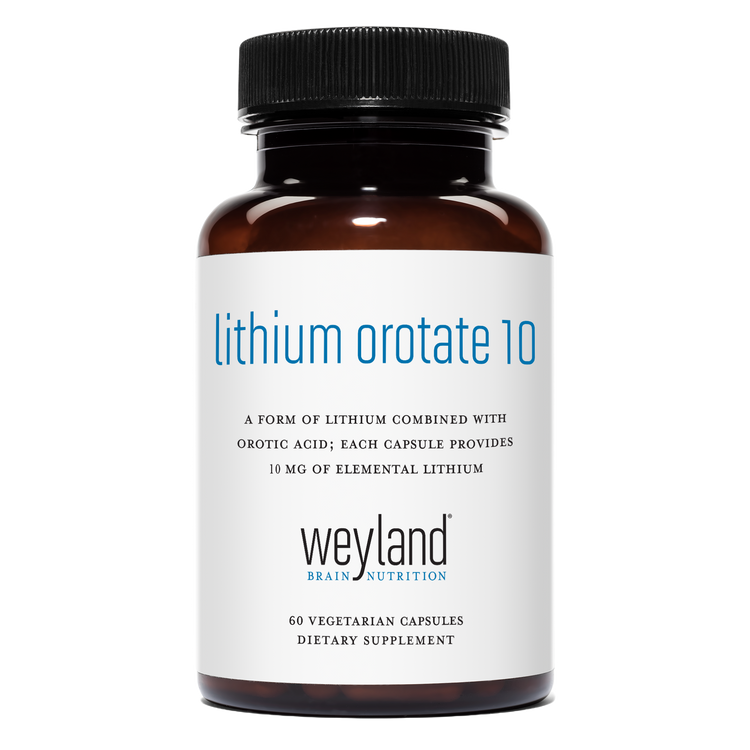
Why Do People Take Low-Dose Nutritional Lithium?
Most people who take low-dose lithium want everyday support for a calm mood and clear thinking. These products usually use the orotate form and come in small, over-the-counter amounts. The reasons people give most often include:
-
General support for a calm, balanced mood
-
Everyday cognitive wellness and mental clarity
-
Support for healthy brain aging
To Support a Calm, Balanced Mood
Many people take low-dose lithium to support a calm, balanced mood from day to day. These supplements are meant for general wellness and are not intended to diagnose, treat, cure, or prevent any disease. They should never replace prescribed drugs for bipolar disorder or depressive episodes. Anyone taking lithium by prescription should talk with a doctor before adding a supplement, since both sources add to the same blood level.
To Maintain Everyday Mental Clarity
Others take low-dose lithium for everyday cognitive wellness, such as staying focused and keeping thoughts clear. These products target daily mental performance rather than any medical condition. Research on low-dose lithium and focus in healthy adults is still limited, so any benefit remains uncertain.
To Support Healthy Brain Aging
Some people take low-dose lithium with long-term brain health in mind. Scientists are studying lithium's possible neuroprotective properties, or ways it may help protect brain cells. A 2025 study published in the journal Nature tied low brain lithium to memory changes in mice, and other studies have compared trace lithium in drinking water with rates of cognitive decline. This research is early and relies mostly on animals or population data. It does not show that any supplement prevents or treats a brain condition

How Are Prescription Lithium Levels Managed?
Doctors manage prescription lithium with regular blood tests that keep serum lithium levels inside a target zone called the therapeutic range. This process is called therapeutic drug monitoring. It matters because two people on the same dose can end up with very different lithium serum levels.
Lab results guide lithium dosing more than pill strength does. Doctors track blood levels, the timing of each test, and anything that can raise or lower the number.
How Doctors Monitor Lithium Blood Levels
Lab results guide lithium dosing more than pill strength does. Doctors track the blood level, the timing of each test, and anything that can push the number up or down.
Knowing the Therapeutic Range
Most labs list therapeutic lithium levels as about 0.6 to 1.2 millimoles per liter (mmol/L). Some report milliequivalents per liter (mEq/L) instead. In clinical chemistry, the two units match for lithium, so 0.8 mmol/L equals 0.8 mEq/L.
Setting Targets for Each Stage of Care
Targets depend on the stage of care. Acute treatment for acute mania often aims for 0.8 to 1.2 mmol/L, and 1.2 mmol/L is a common upper limit. For maintenance treatment in euthymic bipolar disorder, meaning periods of stable mood, an international expert task force recommends 0.6 to 0.8 mmol/L for most adults. The same group suggests 0.8 to 1.0 mmol/L after an insufficient response and lower targets for many older adults.
A 2024 literature review in the International Journal of Bipolar Disorders (Int J Bipolar Disord) found broad agreement that effective levels sit above 0.6 mEq/L, though little data supports that exact cutoff.
Timing and Repeating Blood Tests
Blood is usually drawn about 12 hours after the last dose. Tests happen often after starting lithium and after dose adjustments, then less often once levels are stable. Doctors also order thyroid function tests and check renal function on a regular schedule, since long-term lithium use can affect thyroid function and the kidneys.

Everyday Habits That Affect Lithium Levels
The kidneys handle lithium much like sodium, so some daily habits can slow lithium clearance and raise serum lithium concentrations. These include:
-
Following a low-sodium diet
-
Getting dehydrated
-
Excessive sweating from heat or exercise
Keeping your fluid intake and sodium intake steady helps, and so does avoiding big swings in caffeine.
Signs of Lithium Toxicity
Lithium toxicity usually starts around 1.5 mmol/L, and levels above 2.0 mmol/L can be life-threatening. Signs of lithium poisoning include:
-
Nausea, vomiting, or diarrhea
-
Coarse shaking in the hands
-
Muscle weakness or unsteady walking
-
Confusion, drowsiness, or slurred speech
These toxic symptoms need emergency care right away.
A normal result does not rule out trouble. A 2014 case report in the Shanghai Archives of Psychiatry described an 18-year-old woman with lithium poisoning whose blood test showed normal lithium levels of 0.57 mmol/L. Healthcare professionals weigh both lab results and clinical response, so patient safety depends on watching symptoms as closely as numbers.
Side Effects at Therapeutic Levels
Even at therapeutic levels, lithium commonly causes adverse effects such as:
-
Nausea
-
Tremor
-
Frequent urination
-
Weight gain
Managed well, lithium treatment helps prevent both manic and depressive episodes in bipolar disorder. That balance is why lithium dosing is a core lesson in medical education.
Use the Lithium Range to Guide Your Choices
Across the lithium range, dose sets the purpose and the risk: trace amounts come from food and water, low-dose orotate supplements support daily wellness, and prescription doses need blood tests to stay near 0.6 to 1.2 mmol/L.
Weyland Brain Nutrition offers lithium orotate from 2.5 mg to 20 mg, so you can start with lower doses. Lithium orotate may help support a calm, balanced mood. If you take prescription lithium or have kidney or thyroid problems, talk with a healthcare professional first. Start low, and explore Weyland's lithium orotate for simple daily support.
These statements have not been evaluated by the Food and Drug Administration. This product is not intended to diagnose, treat, cure, or prevent any disease.
Choose a Lithium Option With the Dose in Mind
Understanding elemental lithium makes it easier to compare products and make informed choices. Browse Weyland's collection to see nutritional options designed to support a simple, consistent daily wellness routine.
Shop Weyland Supplements
Frequently Asked Questions
Is lithium orotate the exact same as prescription lithium?
Lithium orotate and prescription lithium carbonate both release lithium in the body, but orotate is a low-dose supplement while carbonate is an FDA-approved drug taken at far higher doses with regular blood tests.
Can a person use over-the-counter lithium supplements for medical conditions?
Over-the-counter lithium supplements are not intended to diagnose, treat, cure, or prevent any disease, so a condition like bipolar disorder calls for a diagnosis and treatment plan from a healthcare professional.
What is the normal serving size for an over-the-counter lithium supplement?
Most lithium orotate supplements provide 1 to 20 mg of elemental lithium per serving, with 5 mg being common, so follow the manufacturer's instructions and check with a doctor before starting.
Does lithium occur naturally in public drinking water?
Lithium occurs naturally in many public water supplies, and amounts vary widely by region based on local rock and soil.
How does the human body absorb different forms of lithium?
The gut absorbs most forms of lithium well once the salt breaks apart, and claims that orotate reaches the brain more easily come mainly from older animal studies rather than strong human research.
References
-
Aron, L., Ngian, Z. K., Qiu, C., Choi, J., Liang, M., Drake, D. M., Hamplova, S. E., Lacey, E. K., Roche, P., Yuan, M., Hazaveh, S. S., Lee, E. A., Bennett, D. A., & Yankner, B. A. (2025). Lithium deficiency and the onset of Alzheimer's disease. Nature, 645(8081), 712–721. https://doi.org/10.1038/s41586-025-09335-x
-
Kessing, L. V., Gerds, T. A., Knudsen, N. N., Jørgensen, L. F., Kristiansen, S. M., Voutchkova, D., Ernstsen, V., Schullehner, J., Hansen, B., Andersen, P. K., & Ersbøll, A. K. (2017). Association of lithium in drinking water with the incidence of dementia. JAMA Psychiatry, 74(10), 1005–1010. https://doi.org/10.1001/jamapsychiatry.2017.2362
-
Manchia, M., Paribello, P., Pinna, M., Steardo, L., Jr., Carpiniello, B., Pinna, F., Pisanu, C., Squassina, A., & Hajek, T. (2024). Lithium and its effects: Does dose matter? International Journal of Bipolar Disorders, 12, Article 23. https://doi.org/10.1186/s40345-024-00345-8
-
Peng, J. (2014). Case report on lithium intoxication with normal lithium levels. Shanghai Archives of Psychiatry, 26(2), 103–104. https://doi.org/10.3969/j.issn.1002-0829.2014.02.008
-
Schrauzer, G. N. (2002). Lithium: Occurrence, dietary intakes, nutritional essentiality. Journal of the American College of Nutrition, 21(1), 14–21. https://doi.org/10.1080/07315724.2002.10719188
Medical Disclaimer
The content on this page is for informational purposes only and is not intended as medical advice, diagnosis, or treatment. Always consult a qualified healthcare professional before making changes to your health regimen.
*These statements have not been evaluated by the Food and Drug Administration. Our products are not intended to diagnose, treat, cure, or prevent any disease.