Posted by GC Support
on April 09, 2026

Table of Contents
Overview
The study “Lithium orotate: A superior option for lithium therapy? by Pacholko et al. (2021). We are summarizing this scientific paper to provide background on a major public health concern affecting millions of people. Bipolar Disorder (BD) affects roughly three percent of people in North America. It causes intense mood cycles ranging from deep depression to extreme mania. For decades, doctors have prescribed heavy mineral salts to stabilize these moods. However, the most common prescription often leads to severe health issues, which makes patients stop taking their necessary medicine.
This scientific paper looks back at an alternative compound abandoned in the 1970s to see whether it could be the key to safer mental health care today.
Compare Weyland’s Lithium Orotate Options in One Place
Reading about lithium compounds is a good first step. If you want to see the different Weyland formulas, strengths, and product formats in one place, this is the easiest next move.
View All Weyland Products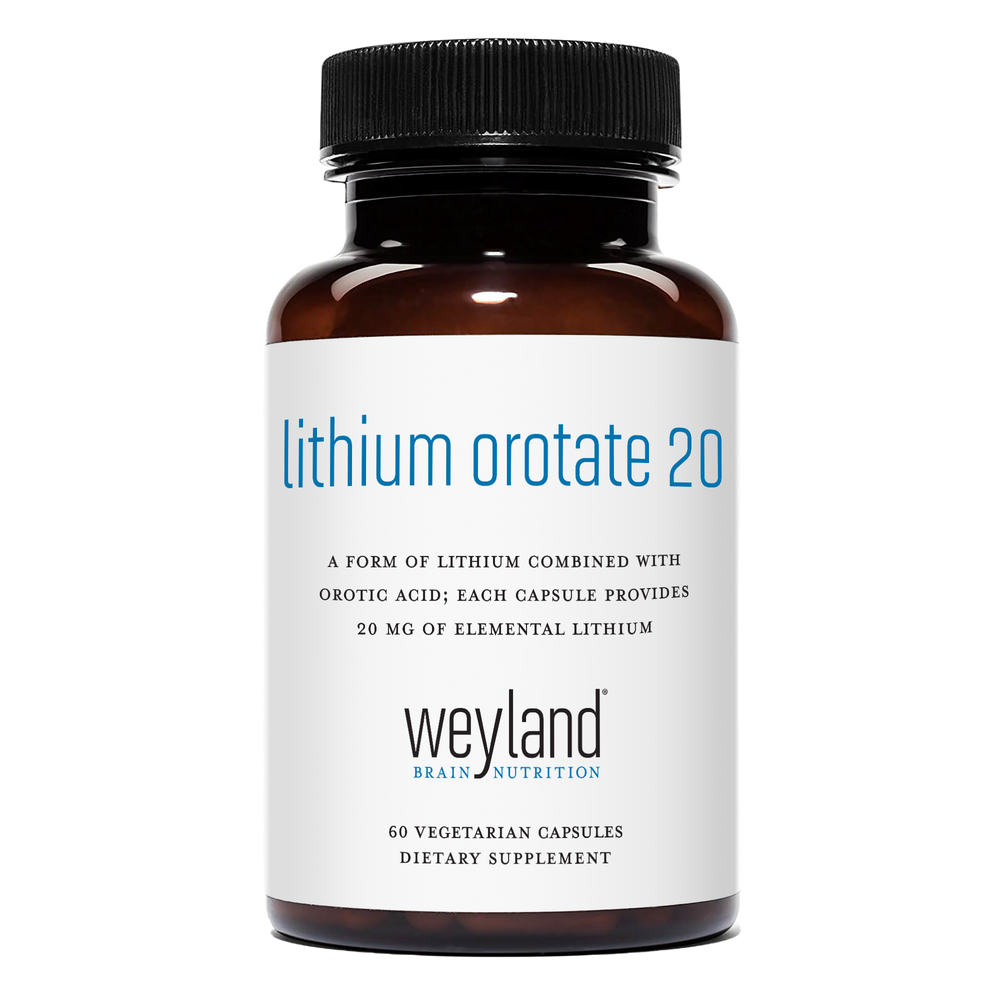
What Is The Background Of Bipolar Disorder Treatment?
To understand the context of this scientific paper, we must look at how doctors currently treat extreme mood shifts. The standard medication is Lithium Carbonate (Li2CO3). It is highly effective at preventing manic episodes and keeping a patient’s mood stable over time. However, the researchers point out a major flaw in this popular therapy. They note that “Li2CO3 is associated with a host of adverse health outcomes following chronic use.”
The etiopathogenesis (the underlying cause) of these extreme mood shifts is incredibly complex. The authors note that the exact biological mechanisms are not fully understood by modern medicine. However, scientists believe that excessive activity of certain brain enzymes, specifically Glycogen Synthase Kinase-3 Beta (GSK3B) and Inositol Monophosphatase (IMPase), plays a massive role in mood instability. When these specific enzymes are hyperactive, they can disrupt a person’s circadian clock and cause harmful neuroinflammation (brain swelling). Lithium salts work by blocking these specific enzymes. The mineral literally takes the place of magnesium in the enzyme, forcing it to slow down and function normally.
Because standard Li2CO3 does not easily cross the Blood-Brain Barrier (BBB), doctors must prescribe very high doses. These high doses force the chemical into the brain, but they also flood the rest of the body. Over time, this leads to very unpleasant side effects. Patients often suffer from:
- Excessive thirst and frequent urination
- Severe thyroid hormone disruption
- Long-term kidney damage and failure
Because these side effects are so harsh, many patients simply stop taking their medication entirely. The authors argue that finding an alternative with a “lesser toxicity profile would dramatically improve treatment efficacy and outcomes.”
Methodology
The methodology of this scientific paper is a comprehensive literature review. The researchers did not conduct a new laboratory experiment on humans or animals. Instead, they systematically gathered historical documents, clinical reports, and early animal studies from the past fifty years. They analyzed exactly why the original prescription became the gold standard and why alternative versions were pushed aside by the medical community.
By comparing old data on cellular biology and organ toxicity, the researchers built a theoretical framework. They examined how different mineral compounds dissolve in the bloodstream and how they interact with specific brain enzymes, such as GSK3B and IMPase. Furthermore, the methodology involved looking at the chemical structure of orotic acid itself. The authors researched how orotic acid is naturally used by the human body to build DNA and RNA. This thorough review methodology enabled the authors to identify significant gaps in current medical knowledge and to propose a clear, step-by-step path forward for future laboratory testing.

Main Findings
Better Passage Into The Brain
The most important finding discussed in this scientific paper is how the alternative compound behaves inside the human body. Lithium Orotate (LiOr) is bound directly to orotic acid. The researchers suggest that this specific pairing creates an electrically neutral compound that does not easily break apart in the stomach or bloodstream. Because it remains neutral, it can slip through cell membranes and enter the central nervous system much more easily than standard prescriptions. The authors reference an older study showing that this compound resulted in “brain lithium concentrations three-fold higher than what were observed for equivalent doses of Li2CO3.” In addition to being a great delivery vehicle, orotic acid may also confer its own health benefits. The scientific paper notes that orotic acid can boost the production of natural antioxidants in the body, which helps protect brain cells from daily damage.
Potential For Much Lower Doses
Because this alternative compound enters the brain so efficiently, the scientific paper suggests that patients might only need a fraction of the normal dose. During standard treatments, the medication must be pushed heavily into the blood to force a small amount across the BBB. If doctors can prescribe much smaller amounts of the orotate version, the rest of the body will not be flooded with excess chemicals. This could theoretically stop the severe side effects that ruin kidney and thyroid health over time. The authors explain that a highly absorbable compound “would theoretically allow for reduced dosage requirements and ameliorated toxicity concerns.” This means patients could get the mental health benefits they need without constantly feeling sick or intensely thirsty.
Unresolved Safety And Toxicity Fears
Despite the exciting potential, the findings heavily highlight past controversies. In the late 1970s, a specific study claimed that this alternative compound caused worse kidney damage than the standard treatment. The authors of this current scientific paper point out a major flaw in that old study. They note that the older tests used incredibly high doses, which defeated the whole purpose of using a highly absorbable compound in the first place. If a chemical enters cells more easily, giving a massive dose will naturally cause severe organ stress. Still, the fear of kidney damage effectively stopped all official medical research for decades. The authors emphasize that these safety concerns must be carefully retested using modern science and appropriate, low doses before anyone can declare the medicine totally safe.

What Are The Clinical Implications For Future Therapy?
The implications of this scientific paper are massive for the future of mental health care. Currently, this alternative compound is sold legally as a cheap, over-the-counter dietary supplement. Because every day people can buy it without a prescription, many individuals are trying to treat themselves at home. The authors find this trend very concerning because there is still a “scarcity of literature concerning its benefits and risks.” While one medical case report showed that a young woman survived an intentional overdose of eighteen supplement pills with only mild nausea, this does not mean daily use is harmless.
If modern scientists can prove that this alternative is both safe and effective at low doses, it could completely change how doctors prescribe mood stabilizers globally. Millions of people who suffer from severe mood swings could finally get relief without destroying their physical health. However, the study explicitly warns that doctors should not recommend it for clinical use at this time. Scientists must first conduct strict animal testing. They need to use advanced magnetic resonance imaging (MRI) to precisely track where the mineral accumulates in the body. After animal testing, large human trials will be needed to confirm exactly how it affects the kidneys and thyroid over the long term.
Explore Weyland’s Full Line of Brain Support Products
Now that you have the key takeaways from the paper, you can continue exploring Weyland’s product lineup. Review the collection and compare available options at your own pace.
Shop Weyland NowA Hopeful Path For Psychiatric Medicine
This scientific paper proves that sometimes the best medical advancements come from looking closely at forgotten research. While standard treatments have saved many lives, their harsh side effects leave much to be desired. This alternative compound offers a fascinating glimpse into a future where mental health treatments are both highly effective and gentle on the human body.
By demanding rigorous new safety tests and clinical trials, the authors of this study are paving the way for safer, more reliable therapies. Until those strict medical tests are entirely complete, patients must continue to work closely with their doctors, avoid unproven internet supplements, and rely on proven medical guidelines to manage their health safely.
References
- Food and Drug Administration. (2021, December 21). Dietary supplements. https://www.fda.gov/consumers/consumer-updates/dietary-supplements
- National Center for Biotechnology Information. (n.d.). PubChem compound summary for CID 967, orotic acid. Retrieved April 9, 2026, from https://pubchem.ncbi.nlm.nih.gov/compound/Orotic-Acid
- National Institute of Mental Health. (n.d.). Bipolar disorder. https://www.nimh.nih.gov/health/statistics/bipolar-disorder
- Pacholko, A. G., & Bekar, L. K. (2021). Lithium orotate: A superior option for lithium therapy? Brain and Behavior, 11(8), e2262. https://doi.org/10.1002/brb3.2262
- Pauzé, D. K., & Brooks, D. E. (2007). Lithium toxicity from an internet dietary supplement. Journal of Medical Toxicology, 3(2), 61–62. https://doi.org/10.1007/BF03160910
- White, K. L., Jr., DeLorme, M. P., Beatty, P. W., Smith, M. J., & Peachee, V. L. (2013). Jet fuel kerosene is not immunosuppressive in mice or rats following inhalation for 28 days. Journal of Toxicology and Environmental Health, Part A, 76(13), 778–797. https://doi.org/10.1080/15287394.2013.819307
Medical Disclaimer
The content on this page is for informational purposes only and is not intended as medical advice, diagnosis, or treatment. Always consult a qualified healthcare professional before making changes to your health regimen.
*These statements have not been evaluated by the Food and Drug Administration. Our products are not intended to diagnose, treat, cure, or prevent any disease.