Posted by GC Support
on June 28, 2026

Table of Contents
Overview
The study, “A Toxicological Evaluation of Lithium Orotate,” by Murbach et al. (2021), is the first formal preclinical safety study of lithium orotate (LO), a supplement sold over the counter for decades. Murbach, Glávits, Endres, Hirka, Vértesi, Béres, and Pasics Szakonyiné conducted a full battery of genetic toxicity tests and a 28-day oral toxicity study in rats. The work was funded by Pure Encapsulations, a supplement company, which is a fact worth flagging up front. Until this study, the safety of lithium orotate had been studied very little despite its wide commercial availability.
Researching Lithium Orotate Safety?
Start with a clean, simple wellness option from Weyland while you learn what the science says about lithium orotate, dosing, and long-term safety.
Shop Weyland Products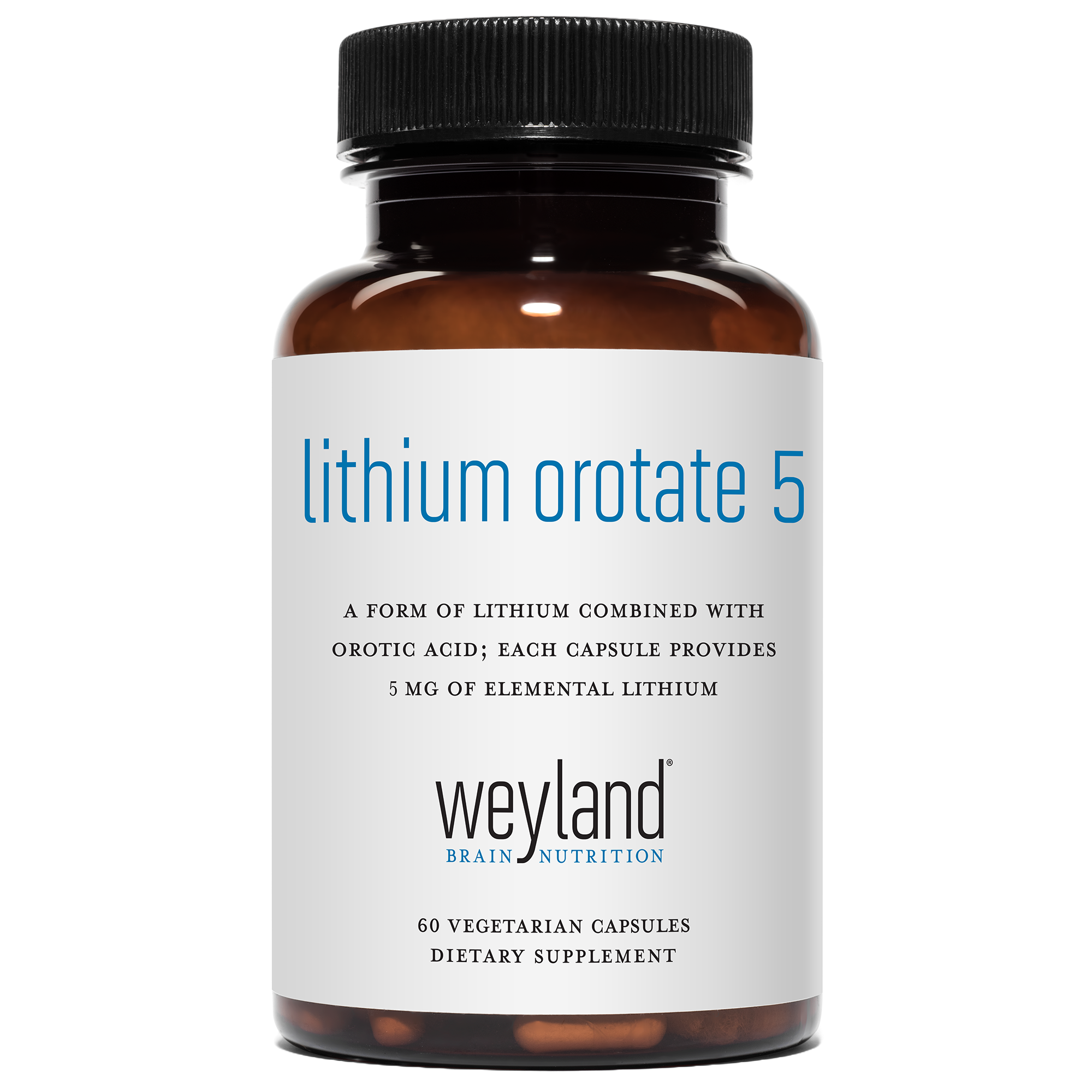
What Is Lithium Orotate and Why Does Its Safety Matter?
Lithium orotate is a salt made from lithium and orotic acid (OA). The molecule contains about 3.86% elemental lithium and 86.14% orotate. When dissolved in water, it breaks apart into a free lithium ion and orotic acid. Supplements typically deliver 1 to 20 mg of elemental lithium per day, though one product the authors found was labeled at 120 mg.
This matters because prescription lithium (mostly as lithium carbonate, or LC) is known for serious side effects. Pharmaceutical lithium has a “narrow therapeutic window,” meaning the dose that helps and the dose that harms are close together. Doctors monitor blood levels closely. The authors note that prescription lithium can cause “renal, neurological, psychiatric, thyroid, parathyroid, cardiovascular, dermatologic, hematologic, and gastrointestinal effects” at therapeutic doses.
Lithium orotate is sold at doses far lower than prescription lithium (about 5.5 to 67 times lower in elemental lithium). It has been on the market in the US and Europe for over 4 decades, with few reported safety problems. But “few reports” is not the same as “tested.” The authors set out to fill that gap.
There is also concern about orotic acid itself. In rats, dietary 1% orotic acid causes fatty liver. Other animal studies have shown tumor-promoting effects in rats, mice, and hamsters. So the safety of lithium orotate is not just about lithium; it is about both pieces of the molecule.

Methodology
The team ran four separate tests:
- Bacterial reverse mutation test (Ames test). This checks if a substance can mutate bacterial DNA. They used five bacterial strains, with and without metabolic activation from rat liver enzymes.
- In vitro mammalian chromosomal aberration test. This checks if the substance damages chromosomes in lab-cultured Chinese hamster cells.
- In vivo mammalian micronucleus test in mice. Mice were given oral doses up to 2,000 mg/kg body weight to look for DNA damage in bone marrow cells.
- 28-day repeated-dose oral toxicity study in rats. Rats received 0, 100, 200, or 400 mg/kg body weight per day of lithium orotate by gavage (oral tube feeding). They tracked body weight, food intake, blood chemistry, organ weights, and ran detailed tissue exams.
All tests followed OECD test guidelines and good laboratory practice (GLP) standards. This is a standard regulatory toxicology package, not a clinical trial.

Main Findings
Lithium Orotate Did Not Damage DNA
In all three genotoxicity tests, lithium orotate came back negative. It did not cause bacterial mutations even at the highest concentration tested (5,000 μg/plate). It did not cause chromosome damage in mammalian cells. It did not cause DNA damage in mouse bone marrow even at the limit dose of 2,000 mg/kg body weight. The authors write that lithium orotate was “unequivocally negative for exhibiting genotoxic potential in a standard battery of tests recommended by ICH” (International Conference on Harmonization).
Rats Tolerated Doses up to 400 mg/kg Body Weight Per Day
Over 28 days, rats receiving lithium orotate showed no clear signs of toxicity. There were no unscheduled deaths. Most rats grew normally and ate normally. The team conducted ophthalmologic exams, behavioral observations, blood tests, and tissue examinations. No target organs were identified.
One Male Rat in the High-Dose Group Had Problems
The authors are honest about a data wrinkle. One male rat in the 400 mg/kg group lost weight, ate poorly, and showed reproductive tract changes, including reduced prostate and seminal vesicle secretions plus thymus lymphocyte depletion. The team called this an “individual finding of indeterminate cause” and not test-related, but they could not fully rule out a connection.
For context, an earlier study by Thakur and colleagues found that prescription lithium carbonate at 800 to 1,100 mg/kg body weight per day caused severe damage to the male reproductive system, including “complete blockage of prostatic and seminal vesicle secretions” and reduced sperm production. The doses Thakur used delivered about 6 to 13 times as much elemental lithium as the high dose in this study. So the picture is mixed: prescription lithium at much higher doses clearly damages male reproduction, while this study found something concerning in one rat, but no pattern across the group.
Liver Enzymes Rose Slightly but Stayed in Normal Range
Both male and female rats showed dose-related increases in alanine aminotransferase (ALT, a liver enzyme) and liver weight. These were statistically significant but remained within the lab’s historical control range and showed no corresponding tissue damage. The authors called these “adaptive changes” rather than toxic effects, but did not rule out a test-item-related cause.
The Study Sets a NOAEL of 400 mg/kg Body Weight Per Day
The no-observed-adverse-effect level (NOAEL) is the highest dose at which researchers observe no harmful effects. Here, the NOAEL was 400 mg/kg body weight per day, the highest dose tested. The authors note this supports “the lack of a postmarket safety signal from several decades of human consumption.”

What Are the Real Limits of This Lithium Orotate Safety Evidence?
The authors are unusually frank about what they did not measure. They did not test thyroid or parathyroid hormones or perform urinalysis. They did not measure how much water the rats drank. They did not measure blood lithium levels in the rats. These are big gaps because the kidney and thyroid are the two main targets of long-term lithium toxicity in humans.
They also ran the study for only 28 days. The serious problems with prescription lithium, like nephrogenic diabetes insipidus and permanent kidney damage, develop “following months to years of treatment.” A 28-day rat study cannot catch that.
The authors do not claim it does. They write: “These results are supportive of the history of use of LO without significant postmarket safety signal generation and both open the door and illustrate the need for additional studies on this widely available form of lithium.”
That is a careful statement. They are not saying lithium orotate is safe forever. They say it passed a basic short-term safety check and deserves further study.
Ready to Compare Your Wellness Options?
After reviewing the safety research, take the next step and browse Weyland’s full product line to find support that fits your health goals and routine.
View All Products
Lithium Orotate Passes a Basic Safety Check, but Long-Term Human Data Are Still Missing
A 2021 preclinical toxicology study found no genotoxic effects of lithium orotate and no clear adverse effects in rats given doses up to 400 mg/kg body weight per day for 28 days. The findings line up with decades of supplement use without major safety alerts. But the study has real limits: it was short, did not test thyroid or kidney function in detail, and did not measure blood lithium levels. Long-term human safety is still untested. Anyone taking lithium orotate, especially at higher doses, should talk to a doctor and watch for kidney and thyroid symptoms.
References
- MedlinePlus. (2017, April 15). Lithium. U.S. National Library of Medicine. https://medlineplus.gov/druginfo/meds/a681039.html
- Murbach, T. S., Glávits, R., Endres, J. R., Hirka, G., Vértesi, A., Béres, E., & Pasics Szakonyiné, I. (2021). A toxicological evaluation of lithium orotate. Regulatory Toxicology and Pharmacology, 124, 104973. https://doi.org/10.1016/j.yrtph.2021.104973
- National Institute of Diabetes and Digestive and Kidney Diseases. (2021, September). Diabetes insipidus. National Institutes of Health. https://www.niddk.nih.gov/health-information/kidney-disease/diabetes-insipidus
- Organisation for Economic Co-operation and Development. (n.d.). OECD guidelines for the testing of chemicals, section 4: Health effects [Book series]. OECD Publishing. https://doi.org/10.1787/20745788
Medical Disclaimer
The content on this page is for informational purposes only and is not intended as medical advice, diagnosis, or treatment. Always consult a qualified healthcare professional before making changes to your health regimen.
*These statements have not been evaluated by the Food and Drug Administration. Our products are not intended to diagnose, treat, cure, or prevent any disease.