Posted by GC Support
on June 11, 2026

Table of Contents
Overview
The study, “Lithium Deficiency and the Onset of Alzheimer’s Disease,” by Aron et al. (2025), was published in Nature, one of the world's top scientific journals. The research team, led by senior author Bruce Yankner at Harvard Medical School (with co-authors Aron, Ngian, Qiu, Choi, Liang, Drake, Hamplova, Lacey, Roche, Yuan, Hazaveh, Lee, and Bennett), looked at lithium in human brains and in mice. Their findings reshape how scientists think about lithium and Alzheimer’s disease.
Support Your Brain Health Routine With Weyland
Reading about lithium and Alzheimer’s disease? Explore Weyland’s wellness products made for people who want simple, research-aware support for daily brain and body health.
Shop Weyland Products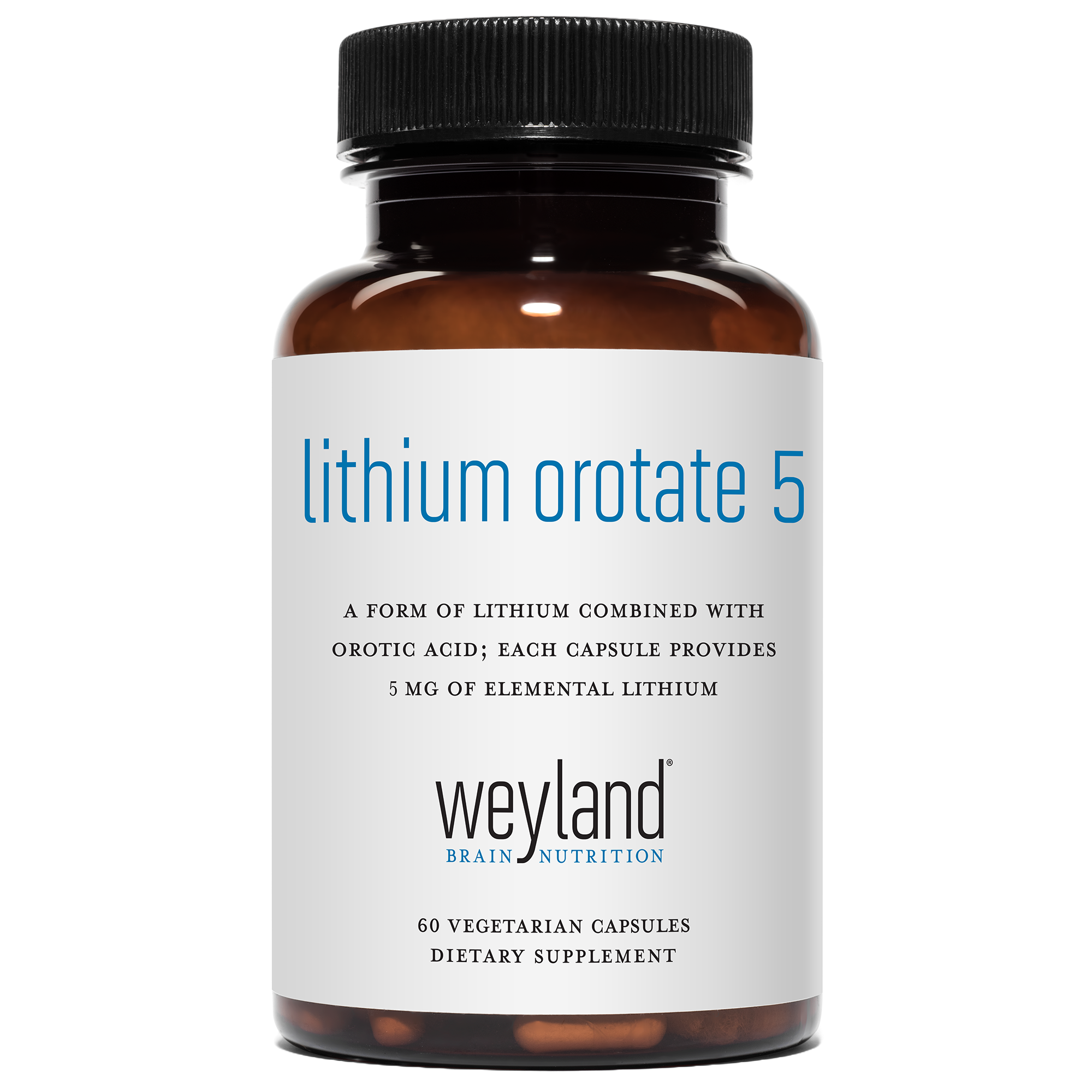
Why Is Lithium and Alzheimer’s Disease Suddenly Getting Attention?
For decades, lithium has been known as a psychiatric drug used in bipolar disorder at high doses. The body also contains small amounts of naturally occurring lithium. Until now, no one knew if that natural lithium did anything important. The Harvard team set out to answer a basic question: Does the brain need lithium to stay healthy as it ages?
The team scanned the brains of older adults and found something striking. Out of 27 metals they tested, lithium was the only one that dropped in the brains of people with mild cognitive impairment (MCI), the stage before Alzheimer’s. The authors write that lithium “was the only [metal] that was significantly reduced in the brain in individuals with mild cognitive impairment.” That makes lithium a possible early warning sign of trouble.

Methodology
The team used several methods. They measured 27 metals in brain and blood samples from older adults with no cognitive problems, with MCI, and with Alzheimer’s disease (AD) using inductively coupled plasma mass spectrometry (ICP-MS). The main sample came from the Rush University ROSMAP study, with a second cohort to confirm findings.
They then ran experiments in three groups of mice: wild-type (healthy) aging mice, J20 mice (an Alzheimer’s model), and 3xTg mice (a more advanced Alzheimer’s model). The team fed some mice a special diet with lithium removed and tracked what happened in the brain. They also tested whether a different lithium salt, lithium orotate (LiO), could fix the problem. Single-nucleus RNA sequencing (snRNA-seq) showed how each brain cell type responded.

Main Findings
Lithium Drops Early in Alzheimer’s Disease
The team found that lithium levels in the prefrontal cortex were significantly lower in both MCI and Alzheimer’s patients compared to healthy older adults. The cerebellum, a brain region less affected by Alzheimer’s, did not show the same drop. Blood lithium levels stayed about the same. This means that something is specifically happening to lithium within the affected brain regions.
The authors also found that lower lithium in the non-plaque part of the brain “correlated with reduced cognitive test scores for episodic and semantic memory, and for a global index of cognitive function.” In plain terms, lower brain lithium levels are associated with worse memory and thinking.
Amyloid Plaques Trap Lithium
The team used a specialized imaging method, laser ablation ICP-MS, to determine exactly where lithium was in the brain. They found lithium was heavily concentrated inside amyloid-beta (Aβ) plaques, the sticky protein clumps that build up in Alzheimer’s. The plaques act like sponges, soaking up lithium and pulling it away from the rest of the brain tissue. This trapping got worse from MCI to full Alzheimer’s.
This finding matters because it suggests amyloid plaques do more than just clog the brain. They also rob brain cells of a metal they need to function.
Removing Lithium From Mouse Diets Caused Alzheimer’s-Like Damage
When the team fed mice a lithium-deficient diet, the results were striking. In 3xTg and J20 Alzheimer’s mice, lithium loss caused more amyloid plaques, more tau protein tangles, and faster memory loss. In healthy wild-type mice with no Alzheimer’s genes, lithium loss still caused:
- Loss of dendritic spines (the points where brain cells connect).
- Loss of myelin (the protective coating around nerve fibers).
- Pro-inflammatory activation of microglia (the brain’s immune cells).
- Memory problems in maze and object recognition tests.
The authors found these effects happened through a kinase called GSK3β, which is known to drive both amyloid and tau buildup in Alzheimer’s. Blocking GSK3β reversed the damage. This is a clear mechanism, not just a correlation.
Brain Gene Expression Changes Match Real Alzheimer’s
The team used single-nucleus RNA sequencing to read which genes turned on or off in each cell type when lithium was removed. The changes overlapped strongly with gene changes seen in actual human Alzheimer’s brains. Microglia (immune cells), neurons, and oligodendrocytes (myelin-making cells) all showed Alzheimer’s-like patterns. This is some of the strongest evidence that lithium deficiency might actually drive the disease, not just accompany it.
Lithium Orotate Reversed Damage and Saved Memory
This is the part most likely to draw attention. The team tested 16 different lithium salts and selected lithium orotate because it bound to amyloid plaques the least. That meant it could deliver lithium to brain cells without getting trapped.
In Alzheimer’s mouse models, lithium orotate at a very low dose (about 1,000 times lower than the dose used in bipolar disorder):
- Almost completely prevented amyloid plaque buildup.
- Reduced tau tangles by a large amount.
- Restored memory in maze tests.
- Reversed damage even when given after symptoms appeared.
In healthy aging mice, lithium orotate prevented age-related inflammation, synapse loss, and memory decline. Long-term use did not raise kidney, thyroid, or other toxicity markers.
The standard psychiatric lithium salt, lithium carbonate, did not work nearly as well at the same dose because it got trapped in plaques.

What Does Lithium and Alzheimer’s Disease Mean for Future Treatment?
The authors are careful, but the findings are exciting. They write: “Disruption of Li homeostasis may be an early event in the pathogenesis of AD. Li replacement with amyloid-evading salts is a potential approach to the prevention and treatment of AD.”
This opens a possible new direction for prevention. A small clinical trial using low-dose lithium has shown some benefit in earlier work cited in the paper, but those trials used lithium carbonate, which the new data suggest is the wrong form. Future trials may need to specifically test lithium orotate.
Take the Next Step in Your Wellness Research
The science is still developing, but staying informed is a strong first step. See Weyland’s full product line and choose support that matches your everyday health routine.
View All Products
Lithium Loss May Be a Hidden Driver of Alzheimer’s, and a New Treatment Path
A 2025 Nature study from Harvard Medical School shows that lithium and Alzheimer’s disease are linked in a way no one expected. Brain lithium drops early, amyloid plaques trap what remains, and the resulting lithium deficit appears to drive the very brain damage that defines the disease. A new lithium salt, lithium orotate, fixed the problem in mice without toxicity. Human trials are the next step, but for the first time, scientists have a clear and testable theory of why Alzheimer’s may begin long before symptoms appear.
References
- Aron, L., Ngian, Z. K., Qiu, C., Choi, J., Liang, M., Drake, D. M., Hamplova, S. E., Lacey, E. K., Roche, P., Yuan, M., Hazaveh, S. S., Lee, E. A., Bennett, D. A., & Yankner, B. A. (2025). Lithium deficiency and the onset of Alzheimer’s disease. Nature, 645(8081), 712–721. https://doi.org/10.1038/s41586-025-09335-x
- Bennett, D. A., Buchman, A. S., Boyle, P. A., Barnes, L. L., Wilson, R. S., & Schneider, J. A. (2018). Religious Orders Study and Rush Memory and Aging Project. Journal of Alzheimer's disease : JAD, 64(s1), S161–S189. https://doi.org/10.3233/JAD-179939
- National Institute on Aging. (2021, April 12). What is mild cognitive impairment? National Institutes of Health. https://www.nia.nih.gov/health/memory-loss-and-forgetfulness/what-mild-cognitive-impairment
Medical Disclaimer
The content on this page is for informational purposes only and is not intended as medical advice, diagnosis, or treatment. Always consult a qualified healthcare professional before making changes to your health regimen.
*These statements have not been evaluated by the Food and Drug Administration. Our products are not intended to diagnose, treat, cure, or prevent any disease.